
Home Blog

Best Time to Visit London: The Perfect 2026 Month-by-Month Guide to Weather, Crowds & Prices

0

London never really has an “off” switch. It’s a city where you can eat breakfast under spring blossom in St James’s Park, shelter from a sudden shower in the British Museum, and finish the day with a pint by the Thames, all in the same 24 hours. That’s exactly why choosing the best time to visit London matters so much: the right month can mean shorter queues, cheaper hotels, drier days and longer evenings.

This guide skips the vague “it depends” answers. Below, you’ll find the best time to visit London based on what you care about most: dodging rain, avoiding crowds, saving money, travelling with kids, enjoying winter festivities or catching a perfect sunset.

Best Time to Visit London at a Glance

Before we dig into the details, here’s a snapshot of the whole year. Use it to shortlist your months, then jump to the section that matches your travel style.

MonthAvg High / LowCrowdsPricesBest For
January8°C / 3°C (46°F / 37°F)LowLowestBudget trips, January sales, museums
February9°C / 3°C (48°F / 37°F)Low (busy at half-term)LowCheap hotels, theatre deals
March12°C / 4°C (54°F / 39°F)Low–MediumLow–MediumEarly blossom, quieter sights
April15°C / 6°C (59°F / 43°F)Medium (high in the East)MediumSpring gardens, London Marathon
May18°C / 9°C (64°F / 48°F)MediumMedium–HighOverall best month, Chelsea Flower Show
June21°C / 12°C (70°F / 54°F)HighHighLongest days, outdoor events
July24°C / 14°C (75°F / 57°F)Very highHighestSunshine, festivals, parks
August23°C / 14°C (73°F / 57°F)Very highHighestNotting Hill Carnival, summer evenings
September20°C / 12°C (68°F / 54°F)MediumMediumSecond-best month, warm and calmer
October16°C / 9°C (61°F / 48°F)Medium (busy at half-term)MediumAutumn colour, film festival
November11°C / 6°C (52°F / 43°F)Low–MediumLow–MediumChristmas lights switch-on, Bonfire Night
December8°C / 4°C (46°F / 39°F)High (festive)HighChristmas markets, Winter Wonderland

Temperatures are long-term averages for central London and can vary year to year.

Best Time to Visit London to Avoid Rain
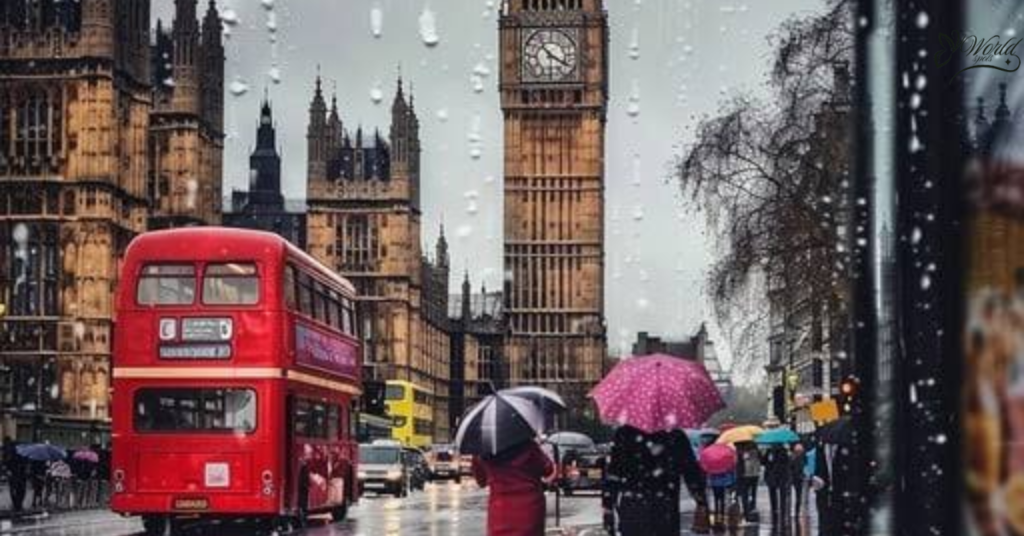
Rainy London street with a red double-decker bus and umbrellas near Big Ben

Let’s clear up the biggest myth first: London isn’t nearly as rainy as its reputation suggests. The city receives roughly 600 mm of rain a year, which is less than Rome, Sydney or New York. The catch is that rain is spread across the year in light, frequent showers rather than big storms, so you may see a drizzle on around 110 days a year.

London has no official rainy season, but there are clear patterns.

Driest Months in London

If staying dry is your top priority, visit London in spring, especially March to May. February and April usually record some of the lowest rainfall totals, while May combines low rainfall with genuinely warm days, which makes it the sweet spot for most travellers.

Late June and July are also relatively dry on most days, although summer can bring short, heavy thunderstorms after a hot afternoon.

Wettest Months in London

October and November are typically London’s wettest months, with October often bringing the most rainy days of the year. December and January are damp too, with more grey, drizzly days than heavy downpours.

What London Rain Is Really Like

Most London rain is light, patchy and short. It’s common to have a 20-minute shower followed by blue sky. Locals rarely cancel plans for rain; they simply carry a compact umbrella or a light waterproof jacket.

Rainy-Day Backup Plans

Even in the driest month, pack a backup plan. London is one of the best cities in the world for indoor sightseeing:

  • Free museums like the British Museum, Natural History Museum, V&A and Tate Modern
  • Covered markets such as Borough Market and Covent Garden
  • A West End show matinee
  • Afternoon tea in a historic hotel
  • The glass-domed Sky Garden, which offers free city views (booking required)

Best Time to Visit London to Avoid Crowds

London welcomes millions of international visitors every year, so it’s never truly empty. But timing your trip well can be the difference between a relaxed stroll through the National Gallery and an hour-long queue for the Tower of London.

Quietest Months in London

The best time to visit London to avoid crowds is:

  1. January to mid-March (outside February half-term): the quietest stretch of the year
  2. Early November: after October half-term and before the Christmas rush
  3. Mid-September to mid-October: summer crowds fade, but the weather is still pleasant

Late September is especially underrated. Schools are back, the summer tour groups have gone home, and you can still enjoy outdoor dining on a warm evening.

When London Is Busiest

Peak season in London runs from June to August, when European and American summer holidays overlap. Expect long queues at headline attractions, packed Tube carriages and the highest hotel rates of the year.

Other crowd hotspots to watch for:

  • Easter holidays (late March or April)
  • UK school half-terms in mid-February, late May and late October
  • Bank holiday weekends, especially the August bank holiday (Notting Hill Carnival)
  • December, especially around Oxford Street, Regent Street and the Christmas markets

How to Beat the Crowds in Any Season

Timing Tips for Popular Attractions

  • Book timed-entry tickets online for the Tower of London, the London Eye, Westminster Abbey and the Churchill War Rooms.
  • Arrive at opening time or go during the last two hours before closing.
  • Visit big museums on weekday mornings or during late-night openings (several, including the V&A and Tate Modern, regularly host late events).
  • Travel outside Tube rush hours (roughly 7:30–9:30 am and 5–7 pm on weekdays).

Cheapest Time to Visit London

London has a reputation as an expensive city, but timing alone can cut your costs dramatically.

Cheapest Months to Visit London

The cheapest time to visit London is January and February, excluding half-term week. After the Christmas and New Year rush, demand falls sharply, and hotels often drop their rates. You’ll also find:

  • Cheaper flights, especially mid-week
  • January sales across major shopping streets
  • West End theatre discounts, often through seasonal deals on selected shows
  • Restaurant offers during the quieter winter weeks

Early March and November (before the festive season) are also good-value months with fewer crowds.

Most Expensive Time to Visit

July, August and December are the most expensive months. Hotel prices peak in summer, and mid-December hotel rates climb again because of Christmas shopping, events and corporate parties.

Budget Tips That Work Year-Round

How to Save Money in London

  • Visit free museums and galleries. The British Museum, National Gallery, Natural History Museum, Science Museum, V&A and Tate Modern are all free to enter (some special exhibitions charge).
  • Tap in with contactless. Using a contactless bank card or phone on the Tube and buses applies daily and weekly fare caps automatically.
  • Ride the bus. London’s iconic red buses are cheaper than the Tube, and a top-deck seat doubles as a sightseeing tour.
  • Stay slightly outside Zone 1. Areas like Southwark, Shoreditch or King’s Cross often offer better value with quick connections.
  • Picnic in Royal Parks. Grab food from a market and enjoy Hyde Park, Regent’s Park or Greenwich Park for free.

Best Time to Visit London with Kids

London is one of Europe’s most family-friendly cities, packed with free museums, huge parks and kid-pleasing attractions. The tricky part is that the best family weather often clashes with the busiest school holidays.

Best Months for a Family Trip

The best time to visit London with kids is late May to June or September:

  • Late May and June bring warm weather, long daylight hours and parks at their greenest. If your children can travel outside UK school holidays, June is ideal.
  • Early to mid-September is warm and noticeably calmer once UK schools return.

If you’re tied to school holidays, Easter and October half-term offer milder crowds than the summer break, plus seasonal family events.

Kid-Friendly Highlights by Season

1. Spring and Summer

  • Picnics and playgrounds in Hyde Park (home to the Diana Memorial Playground in Kensington Gardens)
  • Boat trips along the River Thames
  • ZSL London Zoo in Regent’s Park
  • Outdoor fountains at Granary Square in King’s Cross

2. Autumn and Winter

  • The Natural History Museum and Science Museum in South Kensington
  • Ice skating at seasonal rinks such as the Natural History Museum or Somerset House
  • Hyde Park Winter Wonderland (usually mid-November to early January)
  • Family pantomimes, a classic British Christmas tradition

Family Travel Tips

  • Children under 11 travel free on the Tube and buses when accompanied by a paying adult.
  • Book big-name attractions in advance, especially during school holidays.
  • Build in park time between museums; London’s green spaces are the perfect energy release.

👉 Plan your family trip with our list of family-friendly activities.

Best Time to Visit London in Winter
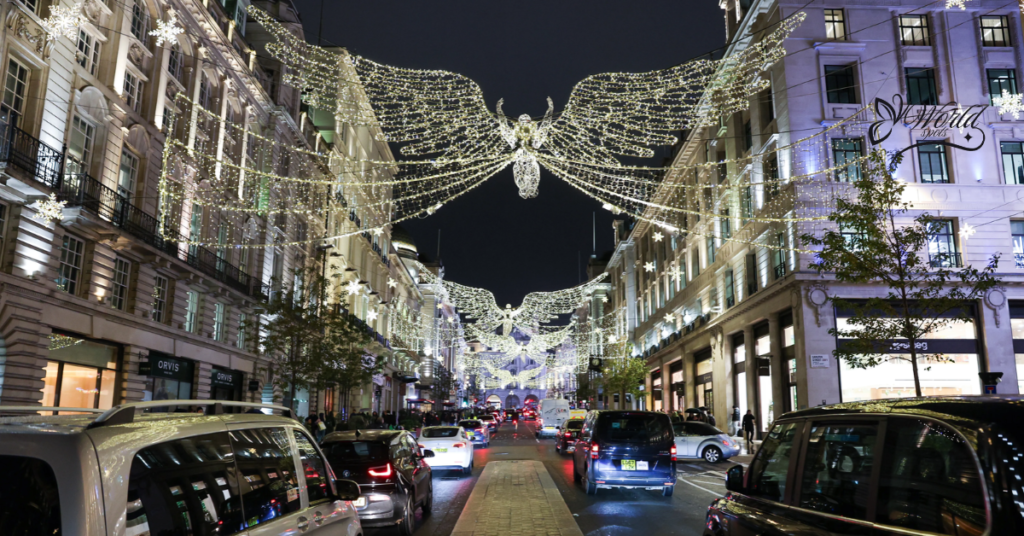
Christmas light angels above Regent Street, London in winter

Winter in London is cold, short on daylight, and surprisingly magical. Temperatures typically sit between 2°C and 8°C (36–46°F), and snow is rare. What winter lacks in sunshine, it makes up for with twinkling lights, cosy pubs and some of the year’s best deals.

December: Festive London

The best time to visit London in winter for atmosphere is late November to mid-December. You’ll get:

  • Christmas lights on Oxford Street, Regent Street, Carnaby Street and Covent Garden
  • Christmas markets at the Southbank Centre, Leicester Square and more
  • Hyde Park Winter Wonderland
  • Festive light trails at places like Kew Gardens

Go before 15 December if you can. As Christmas approaches, crowds and hotel prices both rise, and Christmas Day is unusual: most attractions close and the Tube and buses don’t run.

New Year’s Eve in London

The New Year’s Eve fireworks over the London Eye and Thames are world-famous, but viewing areas along the river are ticketed and sell out quickly. Book early or watch from a rooftop bar or restaurant instead.

January and February: Quiet, Cheap and Cultural

If you prefer value over sparkle, January and February are the best winter months for low prices and short queues. This is the perfect time to explore museums and galleries, catch a West End show and enjoy London’s pub culture, where a log fire and a Sunday roast never feel better.

Lunar New Year celebrations in Chinatown and the West End (late January or February) add a burst of colour to the quietest season.

What to Pack for a London Winter

  • A warm, waterproof coat
  • Layers, because heated museums and Tube carriages can feel warm
  • Comfortable waterproof shoes
  • Gloves, scarf and a hat for evening walks

Best Time to See Sunset in London

London’s skyline at sunset, with the Shard, St Paul’s Cathedral and the Thames glowing gold, is one of the city’s most unforgettable sights. Because London sits far north, sunset times change dramatically through the year.

London Sunset Times by Season

SeasonApprox. Sunset TimeDaylight Hours
Mid-winter (December)~3:50 pm~7.5–8 hours
Spring (March–April)6:00–8:00 pm12–14 hours
Mid-summer (June)~9:20 pm~16.5 hours
Autumn (September–October)6:00–7:30 pm11–13 hours

Clocks move forward one hour on the last Sunday of March and back on the last Sunday of October, so sunset times jump accordingly.

Best Season for London Sunsets

The best time to see sunset in London is late spring to early autumn (May to September). Sunsets happen late in the evening, giving you long golden hours, while warm weather makes rooftop bars and hilltops comfortable.

For softer colours and fewer people at viewpoints, try September. In winter, sunsets come very early (before 4 pm in December), but the low sun and crisp air often produce dramatic pink and orange skies, and you’ll still have time for dinner afterwards.

Best Sunset Spots in London

Free Viewpoints

  • Primrose Hill: a classic panorama of the central skyline
  • Parliament Hill (Hampstead Heath): wide views stretching to the City
  • Waterloo Bridge: views west to Westminster and east to St Paul’s
  • Greenwich Park: overlooking Canary Wharf and the Thames

Rooftop and Indoor Views

  • Sky Garden: free with booking
  • The Shard: paid, with the city’s highest viewing platform
  • The London Eye: time your ride for golden hour

Explore our guide to the global list of the best places to watch sunset.

London Weather and Events Season by Season

Wisteria-covered garden path in London in spring

Every season gives London a different personality. Here’s what to expect, and what’s happening, throughout the year.

Spring in London (March to May)

Spring is when London comes back to life. Cherry blossom, magnolia and wisteria bloom across the city, the parks turn green and outdoor tables reappear outside cafés. Average highs rise from 12°C in March to 18°C in May.

Spring Events

  • St Patrick’s Day celebrations (March)
  • London Marathon (April)
  • Easter events and egg hunts
  • Chelsea Flower Show (late May)

Best for: first-time visitors, sightseeing, parks and gardens.

Summer in London (June to August)

Summer brings London’s warmest weather, with average highs of 21–24°C, though heatwaves can push temperatures past 30°C. Days are long, evenings are bright until after 9 pm, and the city feels like one big outdoor party.

Summer Events

  • Trooping the Colour (June)
  • Wimbledon tennis championships (late June to early July)
  • BST Hyde Park concerts and Pride in London
  • Open-air theatre in Regent’s Park
  • Notting Hill Carnival (August bank holiday weekend)

Best for: festivals, outdoor dining, river cruises and long days. Book hotels early.

Autumn in London (September to November)

Autumn starts warm and golden before turning cool and crisp. September still feels like summer, while October brings beautiful foliage in Richmond Park, Hampstead Heath and Kew Gardens.

Autumn Events

  • Totally Thames Festival (September)
  • London Design Festival (September)
  • BFI London Film Festival (October)
  • Halloween events
  • Bonfire Night fireworks (around 5 November)
  • Lord Mayor’s Show (November)

Best for: culture lovers, photographers and travellers who want good weather without summer crowds.

Winter in London (December to February)

Winter is London’s coldest, darkest and often cheapest season, but it’s also its most atmospheric in December. Expect highs around 8°C, short days and occasional frost.

Winter Events

  • Christmas lights and markets (late November to December)
  • New Year’s Eve fireworks (31 December)
  • New Year’s Day Parade (1 January)
  • Lunar New Year in Chinatown (January or February)

Best for: budget travellers, museum lovers and festive breaks.

London Month by Month: Quick Guide

  • January: Cheapest month, quiet museums, post-Christmas sales.
  • February: Low prices and short queues; avoid half-term week for the best deals.
  • March: Early spring blossom, mild days and few crowds.
  • April: Spring in full swing; busy around Easter and Marathon weekend.
  • May: Arguably the best month to visit London, with warm weather, blooming gardens and pre-summer prices.
  • June: Longest days of the year and lots of outdoor events, though crowds are building.
  • July: Warmest, sunniest and busiest month, with peak prices.
  • August: Summer holidays, Notting Hill Carnival and a lively city atmosphere.
  • September: Warm days, thinner crowds and a strong cultural calendar.
  • October: Autumn colour, film festival and a wetter but cosy city.
  • November: Bonfire Night, Christmas light switch-ons and good-value hotels.
  • December: Peak festive season, Christmas markets and New Year’s Eve.

Our Verdict: When Should You Visit London?

There’s no bad time to visit London, only better times for different travellers:

  • Best overall: May and September
  • Best weather: June to August
  • Fewest crowds: January to early March
  • Cheapest: January and February
  • Best with kids: June or early September
  • Best for festive magic: late November to mid-December
  • Best for sunsets: May to September

Whenever you go, pack layers and a compact umbrella, book major attractions ahead, and leave room for unplanned discoveries. London rewards the curious traveller in every season.

FAQs About the Best Time to Visit London

What is the best month to visit London?

May is often considered the best month to visit London. It offers mild to warm weather, long days, blooming parks, and lower prices than summer. September is a close second.

What is the cheapest month to go to London?

January is usually the cheapest month to visit London, followed by February (outside half-term week). Hotel prices and flight costs typically drop after the Christmas and New Year holidays.

What is the rainiest month in London?

October is typically London’s wettest month, with November close behind. Spring months like March to May tend to be drier.

When is peak tourist season in London?

Peak season in London runs from June to August, with additional peaks during Easter, UK school half-terms and December.

Is London worth visiting in winter?

Yes. Winter offers Christmas lights, festive markets, cosy pubs and the lowest hotel prices of the year in January and February. Just expect short days and chilly temperatures.

What is the sunniest month in London?

July is usually London’s sunniest month, averaging around six to seven hours of sunshine per day.

When does it get dark in London?

In mid-winter, it gets dark around 4 pm. In mid-summer, sunset is after 9 pm, and twilight lasts until nearly 10 pm.

How many days do you need in London?

Three to four days is enough to see the major highlights. With five to seven days, you can explore neighbourhoods and take day trips to places like Windsor, Oxford, or Brighton.

Washington, D.C. Itinerary: The Perfect 1, 2, & 3-Day Plan (2026 Guide)

0

Washington, D.C. is one of the few capitals in the world where the biggest sights cost nothing. The monuments are free, the Smithsonian museums are free, and even the National Zoo is free. Some of the best experiences require timed-entry passes booked weeks ahead, and many first-time visitors only find out at the door.

This Washington, D. C.  itinerary fixes that. Below you’ll find a day-by-day plan for 3 days in  D. C., a family itinerary, a weekend in  D. C.  itinerary, a cherry blossom itinerary, and every booking window you need; all checked for the 2026–2027 travel season.

In this guide:

  • Washington  D. C.  itinerary at a glance
  • 3 days in  D. C.  for first-timers
  • Family itinerary Washington, D. C. 
  • Weekend in  D. C.  itinerary (plus a one-day plan)
  • Cherry blossom  D. C.  itinerary
  • Planning your trip: tickets, transport, where to stay, budget
  • Washington  D. C.  itinerary FAQs

Washington  D. C.  Itinerary at a Glance

 D. C.’s core is compact. Almost everything a first-timer wants to see sits along the National Mall, the 2-mile green strip between the U.S. Capitol in the east and the Lincoln Memorial in the west. Plan your days by zone, not by attraction, and you’ll walk less and see more.

DayZoneHighlights
Day 1Capitol Hill + National MallU.S. Capitol, Library of Congress, Smithsonian museums, Washington Monument, Lincoln Memorial
Day 2White House + Penn QuarterWhite House, Renwick Gallery, National Archives, African American History Museum, National Portrait Gallery
Day 3Tidal Basin + beyondJefferson Memorial, FDR and MLK memorials, Arlington National Cemetery or Georgetown, The Wharf

Wear proper walking shoes. A typical Mall day runs 15,000–25,000 steps, and the distances look much shorter on a map than they feel in July humidity.

3 Days in  D. C.  for First-Timers

Three days is the sweet spot. It’s enough time to see the iconic monuments, go inside the buildings that matter, and still have an evening or two for food and neighborhoods. Here’s the route I’d give a friend visiting for the first time.

Day 1: Capitol Hill and the National Mall

Start in the east and walk west with the sun behind you in the afternoon; perfect light for your Lincoln Memorial photos.

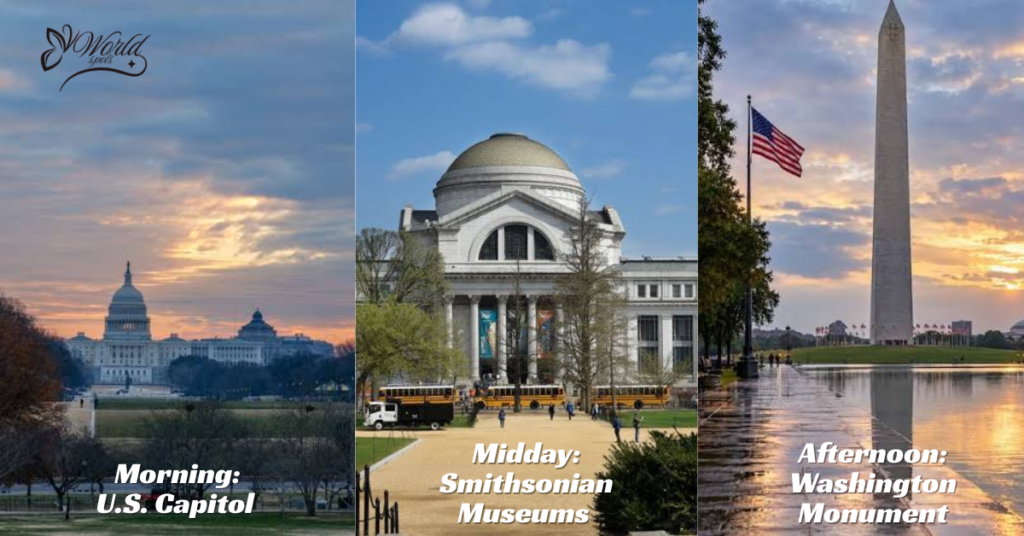
Washington D.C. day 1: U.S. Capitol, Smithsonian museum and Washington Monument

Morning: U.S. Capitol and Library of Congress

Begin at the U.S. Capitol, home of Congress. Visitors enter through the underground Capitol Visitor Center, which is open Monday to Saturday, 8:30 a.m.–4:30 p.m. The guided tour is free, but reserve a slot on the official visitor website; walk-up passes go fast, and the last tour starts at 3:20 p.m.

Two things to know: no food or drinks are allowed inside, and there’s no bag storage, so travel light.

From the Capitol, a tunnel leads straight to the Library of Congress. The Thomas Jefferson Building is arguably the most beautiful interior in the city; gilded ceilings, marble staircases, and the domed Main Reading Room viewed from the gallery above. Free timed-entry tickets are recommended.

Step outside for a photo of the Supreme Court across the street, then head down Capitol Hill toward the Mall.

Midday: Smithsonian Museums on the Mall

You can’t see every Smithsonian museum in one trip, so pick one or two by interest:

  • National Museum of Natural History; the Hope Diamond, dinosaur hall, and the ocean hall. No pass needed.
  • National Air and Space Museum; its multi-year renovation wraps up in fall 2026, so 2027 visitors will see every gallery open for the first time in years. Free timed-entry passes are required.
  • National Museum of American History: the Star-Spangled Banner and First Ladies’ gowns.

Lunch tip: museum cafés are pricey and crowded. Food trucks line the streets near the Mall on weekdays.

Afternoon: Washington Monument and the Memorials

Next, the Washington Monument. An elevator takes you to the observation level for the best 360-degree view of  D. C. . Entry is free, but tickets are required for everyone aged 2+:

  • Advance tickets are released on recreation.gov 30 days ahead at 10 a.m. ET ($1 fee per ticket).
  • Next-day tickets are released at 3 p.m. the day before.
  • Free same-day tickets are handed out at the Washington Monument Lodge on 15th Street from 8:45 a.m., first come, first served.

From the monument, walk west past the World War II Memorial, along the Lincoln Memorial Reflecting Pool, to the Lincoln Memorial itself. On the way, detour to the Vietnam Veterans Memorial and the Korean War Veterans Memorial; both hit harder in person than any photo suggests.

New in 2026: the Lincoln Memorial Undercroft opened as a free exhibit beneath the memorial. It uses timed-entry tickets on recreation.gov ($1 reservation fee).

Evening: The Monuments by Night

Grab dinner, then come back. The memorials are open 24 hours and lit after dark, and the crowds disappear. Seeing Lincoln glowing at 10 p.m. is a highlight many visitors rank above anything they did in daylight.

Day 2: White House, National Archives and Penn Quarter

Washington D.C. day 2: the White House, African American History Museum and National Portrait Gallery

Morning: The White House

Even without a tour, you can photograph the White House from Lafayette Square (north side) and The Ellipse (south side). Inside tours are free and self-guided, but:

  • U.S. citizens request tours through their Member of Congress, generally 21 days to 3 months ahead.
  • International visitors go through their embassy in Washington.
  • Expect a shorter route than older guides describe; the East Wing was demolished in 2025 for the new ballroom project.
  • Bring a REAL ID or passport.

Next door, the Renwick Gallery (free, Smithsonian) is a small, fun museum of contemporary craft and art installations; a perfect 45-minute stop.

Midday: National Archives

Walk east along Pennsylvania Avenue to the National Archives Museum, where the original Declaration of Independence, Constitution, and Bill of Rights are displayed in the Rotunda. Entry is free; reserving a timed slot lets you skip the general line in busy months.

Afternoon: African American History Museum

The National Museum of African American History and Culture (NMAAHC) is the most in-demand museum in D. C., and for good reason. Start in the underground history galleries and work your way up. Free timed-entry passes are required for every visitor, including babies:

  • Advance passes are released 30 days ahead on a rolling basis.
  • Same-day passes release online at 8:15 a.m. ET.

Evening: National Portrait Gallery and Penn Quarter

The National Portrait Gallery and Smithsonian American Art Museum share one building and stay open later than the Mall museums. Don’t miss the presidential portraits, then step into the glass-roofed Kogod Courtyard. Finish with dinner in Penn Quarter or Chinatown, one of the city’s liveliest restaurant areas.

Day 3: Tidal Basin Memorials, Arlington or Georgetown

Morning: Tidal Basin Loop

The Tidal Basin loop (about 2 miles) links three powerful memorials:

  1. Thomas Jefferson Memorial; domed and facing the White House across the water.
  2. Franklin Delano Roosevelt Memorial; four outdoor “rooms,” one for each of FDR’s terms.
  3. Martin Luther King Jr. Memorial; the “Stone of Hope” carved from granite.

Afternoon: Choose Your Adventure

Option A: Arlington National Cemetery. One Metro stop across the Potomac. Watch the Changing of the Guard at the Tomb of the Unknown Soldier, visit the John F. Kennedy gravesite, and walk up to Arlington House for a sweeping view of  D. C. . Entry is free.

Option B: Georgetown. Cobblestone streets, the C&O Canal towpath, waterfront dining and shopping along M Street. Film fans will want the famous steep staircase from The Exorcist.

Evening: The Wharf

End your trip at The Wharf,  D. C.’s waterfront district on the Southwest Channel; seafood, rooftop bars, and free live music on summer weekends.

Family Itinerary: Washington, D. C. 

 D. C.  might be the best-value family destination in the U.S.; the headline attractions are free, many have hands-on zones for kids, and the Metro makes moving around easy. Children under 5 ride Metro free with a paying adult (up to two kids per adult).

Day 1: Dinosaurs, Rockets and the Carousel

  • Morning: National Museum of Natural History; dinosaurs, the Butterfly Pavilion (small fee) and the live Insect Zoo.
  • Midday: Picnic on the Mall, then ride the vintage carousel outside the Smithsonian Castle.
  • Afternoon: National Air and Space Museum; the new “How Things Fly” gallery is built for hands-on learning. Book passes ahead.

Day 2: The National Zoo and Planet Word

Smithsonian’s National Zoo

The National Zoo is free, and the giant pandas are back; Bao Li and Qing Bao arrived from China in late 2024. Go early: the animals are most active in the morning, and the hill back to the entrance is steep with a stroller.

Planet Word

This free language museum downtown has a karaoke room, a talking word wall, and a magic library. Timed passes are recommended for ages 2+.

Day 3: Monuments Made Kid-Friendly

Turn the Mall into a game: hand kids a list of memorials to “find.” In warm months, rent a paddle boat on the Tidal Basin, then finish with the interactive International Spy Museum at L’Enfant Plaza (paid entry; great for ages 8+).

Family Tips That Save Your Sanity

  • Strollers are allowed in most museums; the Capitol Visitor Center has baby-changing stations in its family restrooms.
  • Build in one indoor stop per afternoon in summer;  D. C.  heat is no joke.
  • Use Junior Ranger booklets from the National Park Service at the monuments.

Planning a bigger U.S. family trip? See our guide to family-friendly activities. 

Weekend in  D. C.  Itinerary

Only have Saturday and Sunday? You can still hit the essentials, but remember the Capitol Visitor Center is closed on Sundays, so the Capitol has to happen on Saturday.

Saturday: Capitol to Lincoln

Morning

U.S. Capitol tour (book ahead) → Library of Congress → walk the Mall.

Afternoon

One Smithsonian museum → Washington Monument (reserve your ticket 30 days out) → WWII Memorial → Lincoln Memorial.

Evening

Dinner on 14th Street or U Street, where you’ll find the legendary Ben’s Chili Bowl, a  D. C.  institution since 1958.

Sunday: White House, Archives and Tidal Basin

Morning

White House exterior photos → National Archives (opens at 10 a.m.).

Afternoon

NMAAHC (passes required) or the National Gallery of Art, then a sunset walk around the Tidal Basin memorials.

Only Have One Day in Washington, D. C.?

Short layover or day trip? Follow this one-day  D. C.  itinerary:

  1. 8:00 a.m.; Lincoln Memorial before the crowds
  2. 9:00 a.m.; Vietnam, Korean War, and WWII memorials
  3. 10:30 a.m.; Washington Monument (with tickets)
  4. 12:00 p.m.; Natural History Museum + lunch
  5. 2:30 p.m.; U.S. Capitol tour (book the 2:30–3:20 slot)
  6. 4:30 p.m.; White House exterior via Pennsylvania Avenue
  7. Evening; dinner in Penn Quarter, monuments by night

Cherry Blossom  D. C.  Itinerary

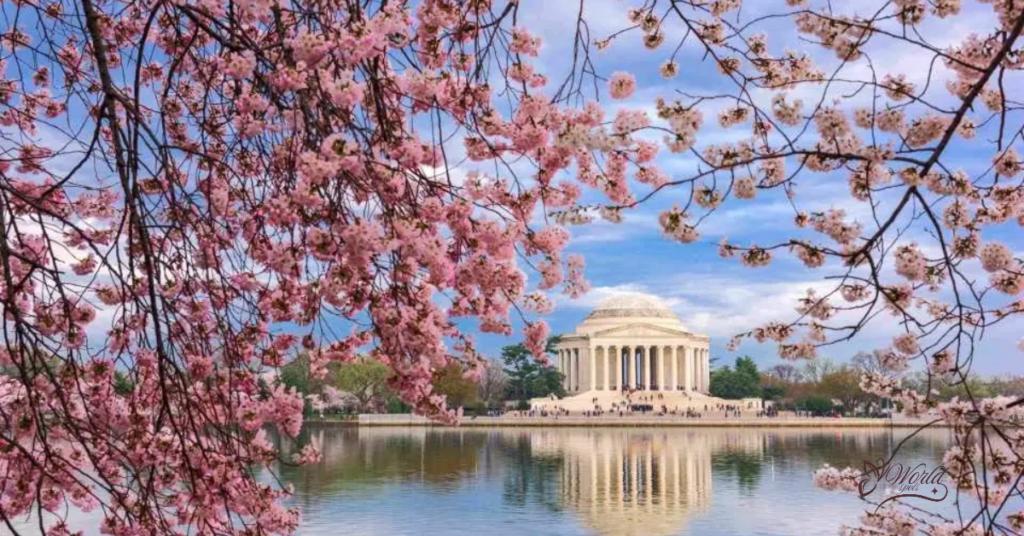
Cherry blossoms around the Jefferson Memorial at the Tidal Basin, Washington D.C.

Spring in  D. C.  belongs to the cherry blossoms, a gift of 3,000 trees from the mayor of Tokyo in 1912. 2027 is a special year: the National Cherry Blossom Festival celebrates its 100th anniversary, with expanded events planned for the centennial. The festival is expected to run from around March 20 to mid-April 2027.

Peak bloom, when most of the Yoshino blossoms are open, usually lands between late March and early April, and only lasts a few days. The National Park Service announces its prediction in early March, so keep your plans flexible.

Day 1: Sunrise at the Tidal Basin

Sunrise

Arrive before 6:30 a.m. Photographers line up for the Jefferson Memorial framed by blossoms, and by 9 a.m. the paths are shoulder to shoulder.

Late Morning

Walk the full loop past the FDR Memorial and MLK Memorial, then grab a snack at the festival’s official welcome area near the Tidal Basin.

Afternoon

Escape the crowds in East Potomac Park (Hains Point), where the later-blooming Kwanzan trees add a second wave of deep pink.

Day 2: Festival Events and Quieter Blooms

  • Blossom Kite Festival on the Washington Monument grounds.
  • National Cherry Blossom Festival Parade along Constitution Avenue (grandstand tickets are paid; standing room is free).
  • Petalpalooza: an all-day outdoor party with live music and fireworks.

For calmer viewing, try the U.S. National Arboretum or the gardens at Dumbarton Oaks in Georgetown.

Cherry Blossom Survival Tips

  • Don’t drive. Take Metro to Smithsonian station and walk 15 minutes.
  • Book hotels early; rates spike during peak bloom.
  • Weekday mornings beat weekend afternoons every time.
  • Never pick or climb the trees; it’s illegal and damages them.

Planning Your Washington, D. C.  Itinerary

Tickets and Timed-Entry Passes to Book in Advance

This is where most first-timers go wrong. Use this checklist:

AttractionCostHow to bookWhen to book
Washington MonumentFree + $1 feerecreation.gov30 days ahead, 10 a.m. ET
U.S. Capitol tourFreeCapitol Visitor Center websiteAs early as possible
NMAAHCFreeSmithsonian website30 days ahead; same-day 8:15 a.m.
Air and Space MuseumFreeSmithsonian websiteWhen dates open
White HouseFreeMember of Congress/embassy21 days–3 months ahead
Lincoln Memorial UndercroftFree + $1 feerecreation.gov30 days ahead

Getting Around Washington, D. C. 

Metro

The Metro is clean, fast, and covers every major sight. Rail fares run 2.25–6.75 per ride, and the 1-Day Unlimited Pass costs $13.50 (or $33.75 for 3 days). Tap a SmarTrip card, phone wallet, or contactless bank card at the gates.

Walking and Bikeshare

On the Mall, walking is fastest. For longer hops, Capital Bikeshare docks are everywhere.

Airports

Reagan National ( D. C. A) is closest and on the Metro. Dulles (IAD) connects via the Silver Line. BWI is linked by MARC or Amtrak train.

Where to Stay in Washington, D. C. 

Penn Quarter / Downtown

Best for first-timers; walk to the Mall, museums, and restaurants.

Capitol Hill

Quieter streets, historic row houses, and Eastern Market on weekends.

Dupont Circle and Logan Circle

Great dining and nightlife, two Metro stops from the action.

Georgetown

Charming and walkable, but no Metro station.

Arlington, Virginia (Rosslyn / Crystal City)

Usually cheaper, and only minutes away on the Metro.

Best Time to Visit Washington, D. C. 

  • Spring (March–May): cherry blossoms and pleasant weather, but peak crowds and prices.
  • Summer (June–August): hot and humid; July 4th fireworks on the Mall.
  • Fall (September–November): the best balance; mild weather, fall color, and thinner crowds.
  • Winter (December–February): cheapest hotels and holiday lights; the National Christmas Tree on the Ellipse.

How Much Does a Washington, D. C.  Trip Cost?

The attractions cost almost nothing, so your budget goes to hotels and food. Expect hotels to be your biggest expense, especially in spring. Save by staying in Arlington, eating lunch from food trucks, and buying a Metro pass instead of taking rideshares.

Washington, D. C.  Itinerary FAQs

How many days do you need in Washington, D. C.?

Three days is ideal for first-time visitors; enough for the National Mall, a few museums, the White House area, and one neighborhood. With two days, you can cover the highlights; with four or five, you can add Mount Vernon, Alexandria, or more museum time.

Are the museums in Washington, D. C., really free?

Yes. All Smithsonian museums and the National Zoo are free, as are the National Gallery of Art, National Archives, and Library of Congress. A few popular sites require free timed-entry passes, and private attractions like the International Spy Museum charge admission.

Can you tour the White House without booking ahead?

No. Public tours must be requested in advance, through your Member of Congress if you’re a U.S. citizen, or your embassy if you’re an international visitor. Without a tour, you can still see the White House from Lafayette Square and the Ellipse.

When is the best time to see the cherry blossoms in  D. C.?

Peak bloom usually falls between late March and early April. In 2027, the National Cherry Blossom Festival marks its 100th anniversary, so expect bigger crowds than usual; book early.

Is Washington, D. C.  walkable?

Very. The National Mall is about 2 miles end to end, and most major sights are within walking distance of each other. Use the Metro to reach Arlington, the Zoo, and outer neighborhoods.

What should I skip on a short  D. C.  trip?

On a one- or two-day visit, skip trying to “do” every museum. Choose one or two Smithsonian museums and spend the saved time at the monuments, which are the experiences you can’t get anywhere else.

Final Thoughts:

The secret to a great  D. C.  itinerary isn’t squeezing in more sights; it’s booking the right passes early, grouping attractions by zone, and saving the monuments for night when the city goes quiet. Follow this plan, and you’ll see the capital the way locals wish every visitor would.

Exploring more of the U.S.? Don’t miss our guide to the places to visit in America.

Landmarks and Famous Sites: Northeast Region, US (2026 Guide)

0

In a single week in the Northeast, you can walk the room where the US Constitution was written, feel the spray of Niagara Falls, and drive to a lighthouse that George Washington helped to create. Few parts of America pack in so much history and scenery so close together.

This guide shows you what to see in each state, the true stories behind each place, and what it costs in 2026. 

Landmarks and Famous Sites Northeast Region, US at a Glance

The US Census Bureau counts nine states in the Northeast. They split into two groups: New England (Connecticut, Maine, Massachusetts, New Hampshire, Rhode Island, and Vermont) and the Middle Atlantic (New York, New Jersey, and Pennsylvania).

Short on time? Start with these:

LandmarkStateFamous forAdult cost (2026)
Statue of LibertyNew YorkSymbol of freedomFrom about $25.50
Empire State BuildingNew YorkArt Deco skyscraperFrom $44
Brooklyn BridgeNew York1883 engineering featFree to walk
Central ParkNew YorkCity’s great green spaceFree
Niagara FallsNew YorkThundering waterfallsFree park entry
Freedom TrailMassachusetts16 Revolutionary sitesFree to walk
Independence HallPennsylvaniaBirthplace of the nation$1 booking fee
GettysburgPennsylvaniaCivil War turning pointBattlefield free
FallingwaterPennsylvaniaHouse over a waterfallFrom $42
The BreakersRhode IslandGilded Age mansion$32
Acadia National ParkMaineRocky Atlantic coast$35 per vehicle
Mount WashingtonNew HampshireHighest Northeast peakVaries by route

Landmarks and Famous Places in the Northeast, State by State

The states here are small, so you can easily link several places into one trip. Start with whichever city you fly into, then work outward.

New York: The Icons Everyone Knows

New York holds more famous names than any other Northeast state. 

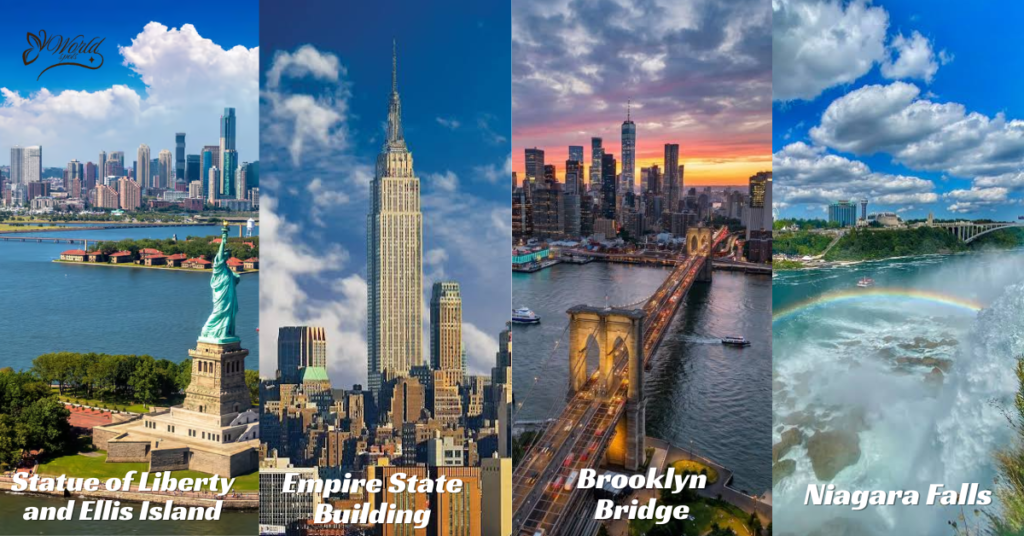
New York landmarks: Statue of Liberty and Ellis Island, Empire State Building, Brooklyn Bridge and Niagara Falls

i. Statue of Liberty and Ellis Island

A gift from the people of France, the statue was dedicated on October 28, 1886, and stands 305 feet from the ground to the torch. Ferries run continuously out of Manhattan’s Battery Park alongside New Jersey’s Liberty State Park. Each entry pass grants access to Ellis Island, the historic gateway that welcomed more than 12 million newcomers between 1892 and 1954.

Plan for this one:

  • Crown: advance tickets are required, and you must climb at least 162 steps on a narrow spiral staircase. Tickets often sell out months ahead.
  • Timing: take an early ferry if you want to see both islands in one day.

ii. Empire State Building

Opened in 1931 after about 13 months of construction, this 102-story tower was the world’s tallest building for decades. The 86th-floor deck gives you a classic open-air view from 1,050 feet, and the 102nd floor adds 200 feet more for a higher price.

iii. Brooklyn Bridge

Opened on May 24, 1883, the bridge is about 1.1 miles long, including its approaches. Walk it on the raised pedestrian promenade, which has been for walkers only since cyclists got their own lane in 2021. Go early, because it gets very crowded by midday.

iv. Central Park

At 843 acres, this National Historic Landmark runs 2.5 miles through Manhattan and is the most visited urban park in the US. Frederick Law Olmsted and Calvert Vaux won the design contest in 1858. It is free, so it makes a perfect break between paid attractions.

v. Niagara Falls

Niagara Falls State Park, created in 1885, is claimed to be the oldest continuously operating state park in the US, and there is no general admission fee. From Goat Island, you get close to the American, Bridal Veil, and Horseshoe Falls. Maid of the Mist and Cave of the Winds cost extra and can sell out early. 

Massachusetts: Where the Revolution Began

Boston is one of the easiest cities in America to explore on foot, and its best-known landmark is literally a walk.

i. The Freedom Trail

This 2.5-mile route links 16 historic sites, from Boston Common to Charlestown. Walking it is free, though some sites charge admission. Don’t miss these:

  • Faneuil Hall: the 1742 meeting hall known as the “Cradle of Liberty”
  • Paul Revere House and Old North Church in the North End
  • USS Constitution: launched in 1797 and the world’s oldest commissioned warship still afloat

Pennsylvania: From Independence to Fallingwater

Pennsylvania tells America’s story at both of its greatest turning points, and it adds one of the world’s most admired houses.

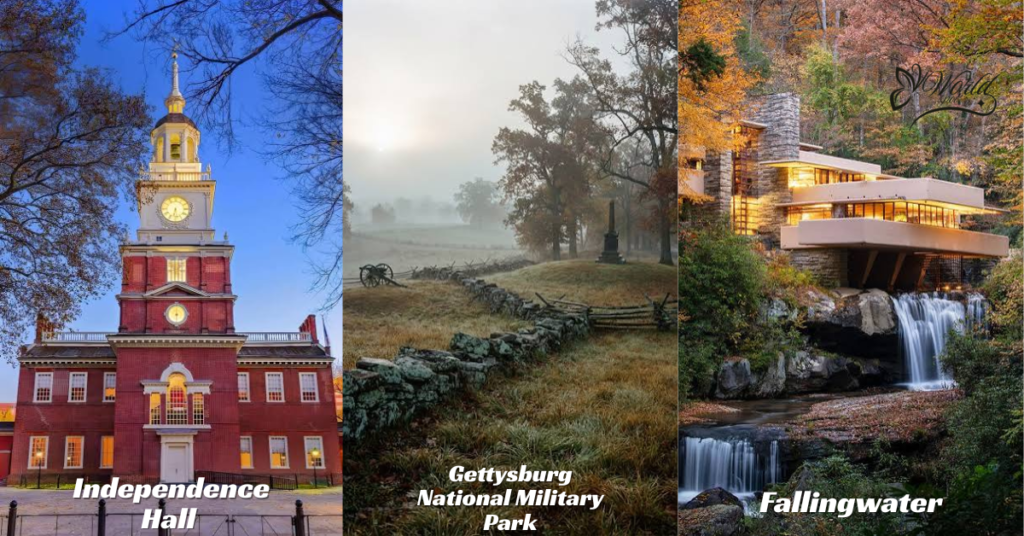
Pennsylvania landmarks: Independence Hall, Gettysburg National Military Park and Fallingwater

i. Independence Hall and the Liberty Bell

The Declaration of Independence was adopted here in 1776, and the US Constitution was drafted here in 1787. Tickets are free, apart from a $1 reservation fee. You can book up to 30 days ahead on Recreation.gov, or try for next-day tickets at 5 p.m. the day before.

The Liberty Bell is a short walk away and needs no ticket. 

ii. Gettysburg National Military Park

Fought from July 1 to 3, 1863, this was the bloodiest battle of the Civil War, with roughly 46,000 to 51,000 casualties. The battlefield itself is free. The visitor center’s film, cyclorama, and museum cost $20.75 for adults and are worth buying first, because they make sense of the landscape you are about to see.

iii. Fallingwater

Frank Lloyd Wright designed this house over a waterfall in 1935, and 2026 marks its 90th anniversary, following a three-year preservation project. It is about 90 minutes from Pittsburgh, tours are closed on Wednesdays, and you must reserve ahead. The guided tour costs $42, and children under 6 can’t join it.

Rhode Island: Gilded Age Glamour

i. The Breakers

Built from 1893 to 1895 for Cornelius Vanderbilt II, this 70-room mansion is the star of Newport’s oceanfront estates. Adult tickets cost $32 and are sold for a specific date and time, so book before you drive down. 

Maine: Lighthouses and Atlantic Granite

Maine’s coast is the wild counterpoint to all those cities, and it rewards anyone willing to drive a few extra hours.

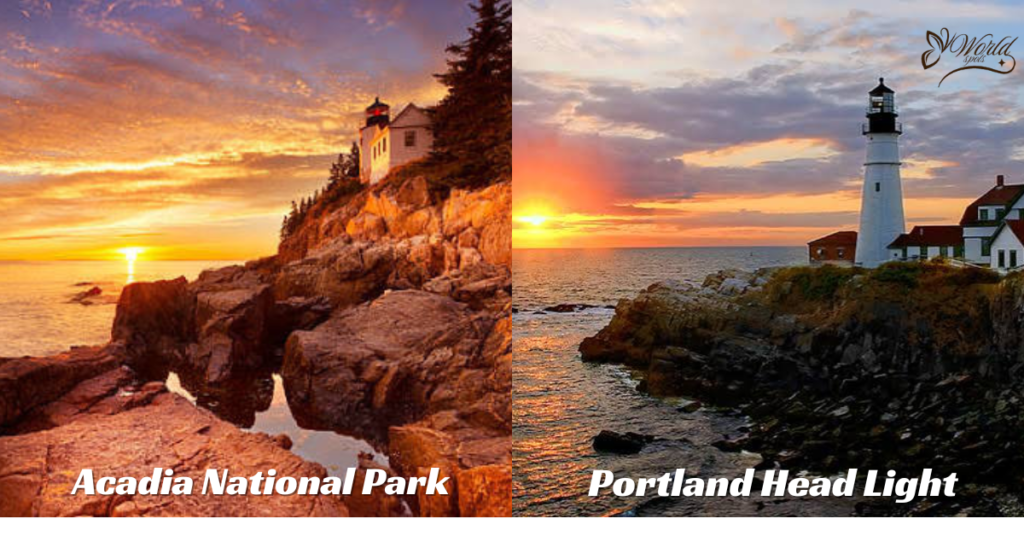
Maine landmarks: sunrise at Acadia National Park and Portland Head Light

i. Acadia National Park

Acadia mixes pink granite shoreline, forest, and Cadillac Mountain. A vehicle pass costs $35 for seven days. Driving up Cadillac needs a separate $6 timed reservation from May 20 to October 25, sold online only.

International visitors, take note: since January 2026, non-US residents aged 16 or older pay an extra $100 per person at Acadia, unless they hold an annual pass. It is the only Northeast park on the list of 11 charging this fee. 

ii. Portland Head Light

First lit in 1791, this is Maine’s oldest lighthouse and the first built by the US government. It stands in Fort Williams Park, just outside Portland, and the old keeper’s house is now a small maritime museum.

New Hampshire: The Top of the Northeast

i. Mount Washington

At 6,288 feet, this is the highest peak in the Northeast. You can hike, drive the Auto Road, or ride the Cog Railway to the top. Pack warm layers even in summer, because the weather up there is famously severe.

Connecticut, New Jersey and Vermont: Three Smaller Stops

The remaining three states have fewer household names, but each has a worthwhile stop:

  • Connecticut: the Mark Twain House in Hartford, the author’s family home
  • New Jersey: Thomas Edison National Historical Park in West Orange, the inventor’s laboratory and estate
  • Vermont: the Bennington Battle Monument, a 306-foot stone obelisk and the state’s tallest structure

Landmarks Famous in the World: Why the Northeast Stands Out

The Northeast holds several landmarks famous around the world, and a few of them have international connections that surprise people.

i) Three UNESCO World Heritage Listings

Three places in this guide appear on the UNESCO World Heritage List:

  • Independence Hall (1979)
  • Statue of Liberty (1984)
  • Fallingwater (2019, with other Frank Lloyd Wright buildings)

ii) The Eiffel Connection

The Statue of Liberty is partly French engineering. Frédéric Auguste Bartholdi sculpted it, and Gustave Eiffel, of Eiffel Tower fame, built the iron framework inside it.

iii) A Waterfall Shared With Canada

Niagara is an international landmark in the literal sense, as the Horseshoe Falls straddles the US-Canada border. The New York side gets you close to the water, while the Canadian side is known for its wider view. If you plan to cross, carry your passport and check your entry rules first.

Famous Landmarks and Their Names: What They Really Mean

Many of these landmarks began with different names. Knowing the stories behind them makes for a better visit, and a good bit of trivia along the way.

Today’s nameOriginal or full nameThe story
Statue of LibertyThe Statue of Liberty Enlightening the WorldThe official title is far longer
Independence HallPennsylvania State HouseRenamed in the 1820s
Liberty BellState House BellRenamed by abolitionists
Old IronsidesUSS ConstitutionA nickname from battle
Faneuil HallSame nameNamed for donor Peter Faneuil
Empire State BuildingSame name“Empire State” is New York’s nickname
FallingwaterKaufmann residenceNamed for the falls beneath it
The BreakersSame nameNamed for waves breaking on the rocks below
Mount WashingtonSame nameHonors George Washington

Famous Landmarks and Tourist Attractions: How to Plan Your Trip

The landmarks above are the highlights, but the best trips mix in other tourist attractions too. Here is how to fit it all together.

Attractions to Add Along the Way

Fall foliage: New England’s autumn colors draw visitors from around the world, usually peaking from late September into October, with the far north turning first. 

Museums: New York, Boston, and Philadelphia all have world-class collections, which make a good rainy-day backup.

More of America: our guide to places to visit in America covers the rest of the country.

How to Get Around

  • Train: Amtrak’s Northeast Corridor links Boston, New York, and Philadelphia, and it is often easier than driving and paying for city parking.
  • Car: You will need one for Acadia, Mount Washington, Fallingwater, and Gettysburg. Pick it up as you leave the city, not before.
  • On foot: Boston and central Philadelphia are compact enough to explore without any transport for most of the day.

When to Go

  • Spring: mild weather and smaller crowds, though some seasonal attractions are only just opening.
  • Summer: everything is open, but expect peak prices and queues, plus heat in the cities.
  • Fall: the favorite season for many, with cool air and foliage. Book rooms early, particularly in New England.
  • Winter: cold and snowy, with low crowds in cities, but mountain and coastal roads may be limited.

Booking Checklist

Book these first, as they are the most likely to sell out or need a timed slot:

  1. Statue of Liberty crown: as early as you can
  2. Independence Hall: up to 30 days ahead
  3. Fallingwater tours: required in advance
  4. Cadillac Summit Road: in season, online only
  5. The Breakers: timed tickets for a set date

A Simple 7-Day Route

  1. Days 1 to 3: New York City, including the Statue of Liberty, Brooklyn Bridge, Central Park and the Empire State Building
  2. Day 4: Train to Philadelphia for Independence Hall and the Liberty Bell
  3. Day 5: Train to Boston and walk the Freedom Trail
  4. Day 6: Rent a car and visit Newport for The Breakers
  5. Day 7: Drive north to Portland Head Light

With extra days, add Acadia, Mount Washington, or Niagara Falls. Note that Niagara sits in far western New York, so it needs its own leg.

Frequently Asked Questions

What are the most famous landmarks in the Northeast US?

The best-known are the Statue of Liberty, Empire State Building, Brooklyn Bridge, Independence Hall, the Freedom Trail, and Niagara Falls. For nature, add Acadia and Mount Washington.

Which states are in the Northeast region?

The Census Bureau lists nine: Connecticut, Maine, Massachusetts, New Hampshire, New Jersey, New York, Pennsylvania, Rhode Island, and Vermont. Some school materials also add Delaware and Maryland.

Is the Liberty Bell free to visit?

Yes. No ticket is required. Independence Hall nearby is also free to enter, but its tickets carry a $1 reservation fee.

How much does it cost foreign visitors to enter Acadia?

Non-US residents aged 16 or older pay an extra $100 per person on top of the normal entrance fee, unless they hold an annual pass.

How many days do you need to see the Northeast?

Seven days cover New York, Philadelphia, Boston, and Newport. Allow 10 to 14 days to add Maine, New Hampshire, and Niagara Falls.

What is the best time to visit?

Late September to mid-October is hard to beat for foliage and comfortable walking weather, though summer is best if you want every seasonal attraction open.

Start With One City

You can’t see every landmark and famous site in the Northeast region of the US in one trip, and you don’t need to. Choose one city, walk its history, and let the next destination come naturally. When you are ready for more, our Guide for Places to Visit Around the World has plenty of ideas.

Best Places to Visit in Cape Town (2026 Guide With Prices, Tips & Travel Plan)

0

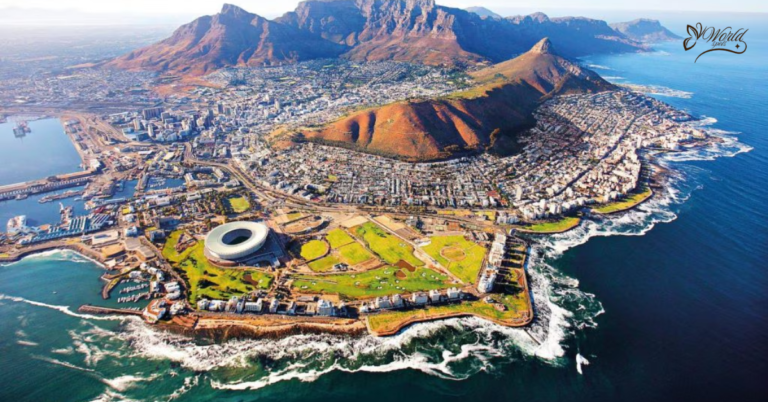
Cape Town is the kind of city that makes other cities feel dull. One morning you are riding a cable car to the top of a flat-topped mountain, by lunch you are watching African penguins waddle across a beach, and by sunset you are sipping coffee on a cliff road where the Atlantic crashes 100 metres below.

If you are searching for the best places to visit in Cape Town, this guide gives you everything in one place: the famous icons, the hidden local favourites, the best neighbourhoods to live and stay in, real 2026 entry prices, and a simple 3-day itinerary you can copy.

Unlike most lists, we have grouped every spot by area, so you can plan your days around geography instead of zig-zagging across the city in traffic.

Quick facts before you go:

  • Nickname: The Mother City
  • Currency: South African Rand (ZAR / R)
  • Best time to visit: November to March (dry, sunny summer)
  • Days needed: 3 days minimum, 5–7 days ideal
  • Getting around: Uber/Bolt, MyCiTi bus, or a rental car for the peninsula

Places in Cape Town: Must-See Spots at a Glance

Short on time? Here is the full list in one table. Bookmark it, then scroll down for the details, tips, and photos of each place.

Sr. #PlaceAreaBest ForCost
1Table MountainCity BowlViews, hikingPaid (cable car) / free hike
2Lion’s HeadCity BowlSunrise & sunset hikeFree
3Signal HillCity BowlEasy sunset viewpointFree
4V&A WaterfrontWaterfrontFood, shopping, familiesFree entry
5Robben IslandTable BayHistoryPaid
6Bo-KaapCity CentreColourful streets, cultureFree
7Company’s GardenCity CentreRelaxing, museumsFree
8Kirstenbosch GardensSouthern SuburbsNature, picnicsPaid
9Camps Bay & CliftonAtlantic SeaboardBeachesFree
10Sea Point PromenadeAtlantic SeaboardWalking, cyclingFree
11Chapman’s Peak DriveHout BayScenic driveToll
12Boulders BeachSimon’s TownPenguinsPaid
13Cape PointCape PeninsulaCliffs, lighthousePaid
14Kalk BayFalse BayHarbour, seafoodFree
15MuizenbergFalse BaySurfing, beach hutsFree
16Hidden gems & day tripsVariousCulture, wine, marketsMixed

Places in Cape Town, South Africa: The Iconic City Spots

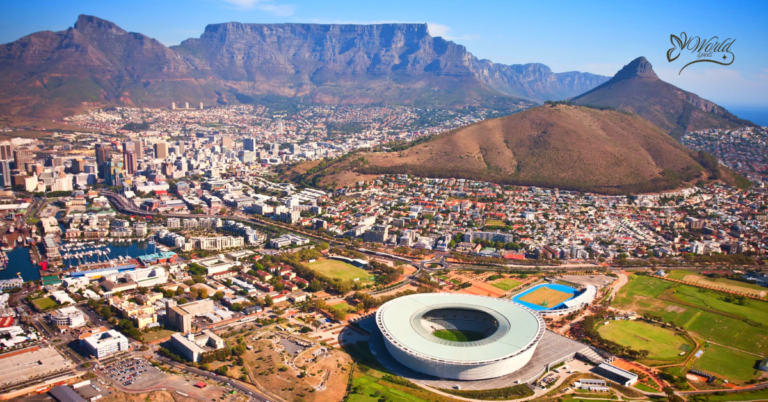
Cape Town sits at the southwestern tip of South Africa, squeezed between mountains and two oceans. Most first-time visitors spend their first day or two in the City Bowl, the natural amphitheatre formed by Table Mountain, Lion’s Head, and Signal Hill. These are the places that put Cape Town on every bucket list.

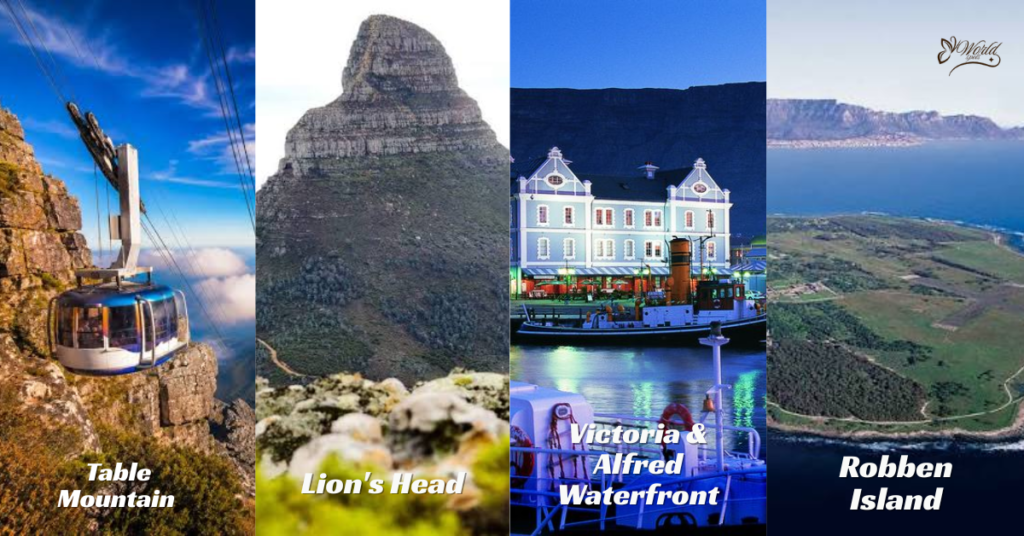
Cape Town landmarks: Table Mountain cableway, Lion's Head, V&A Waterfront and Robben Island

Mountains and Viewpoints

i-  Table Mountain

Table Mountain is the symbol of the city and one of the New 7 Wonders of Nature. You can reach the 1,085-metre summit in two ways:

  • The Aerial Cableway: a 5-minute ride in a rotating cable car. Buy tickets online, as prices are lower than at the ticket office and queues are shorter.
  • Hiking: the most direct route is Platteklip Gorge (about 2–3 hours up). It is steep but well-marked. More scenic routes like India Venster and Skeleton Gorge are best done with a guide.

Pro tip: The cableway closes in strong wind or thick cloud (locals call the cloud the “tablecloth”). Check the official cableway app on the morning of your visit, and go on the first clear day of your trip rather than saving it for the end.

ii- Lion’s Head

Lion’s Head is the hike locals love most. The trail spirals around the peak and ends with a short section of chains and ladders near the top. Allow 2–3 hours return.

Go for sunrise for quieter trails, or join the famous full-moon hike crowd for sunset. Always hike in a group, carry a headlamp, and do not attempt the chain section if you are uncomfortable with heights; there is an alternative path around it.

iii- Signal Hill

Not a hiker? Signal Hill gives you a similar panorama with zero effort. You can drive almost to the top and watch the sun drop into the Atlantic, with Robben Island visible in the distance. Bring a blanket and snacks; this is one of the best free things to do in Cape Town.

iv- Camps Bay and Clifton Beaches

Camps Bay is the glamorous beach with palm trees, white sand, and the Twelve Apostles mountain range behind it. Just north, the four Clifton beaches are sheltered from the wind and reached by steep staircases. For an easier photo stop, try Maiden’s Cove between the two.

Heads-up: The Atlantic water is cold, often around 12–16°C, even in summer. Come for the sunbathing and sunsets; save the swimming for False Bay.

 Waterfront and History

i- Victoria & Alfred Waterfront

The Victoria & Alfred Waterfront is a working harbour turned into Cape Town’s busiest leisure hub. Inside one walkable area, you will find:

  • The Two Oceans Aquarium (great for families)
  • Zeitz MOCAA, the largest museum of contemporary African art, inside a converted grain silo
  • The Cape Wheel for city views
  • Harbour and seal cruises
  • Food markets, restaurants, and shopping

It is also one of the safest areas in the city to walk around in the evening.

ii- Robben Island

Ferries leave from the Nelson Mandela Gateway at the Waterfront for Robben Island, the UNESCO World Heritage Site where Nelson Mandela was imprisoned for 18 years. The tour includes a bus ride around the island and a walk through the maximum-security prison, often guided by a former political prisoner.

Book through the official Robben Island Museum channel well in advance; tours sell out in summer, and ferries are cancelled in rough seas.

 Culture in the City Centre

i- Bo-Kaap

Bo-Kaap is the neighbourhood of brightly painted houses you have seen all over Instagram. But it is far more than a photo spot. It is the historic heart of the Cape Malay community, with cobbled streets, mosques, and some of the best Cape Malay cuisine in the country. Visit the Bo-Kaap Museum, or better still, join a local cooking class to learn how to make samoosas and curry.

Please be respectful: these are people’s homes, so avoid blocking doorways for photos.

ii- Company’s Garden and the Museum Mile

Company’s Garden was planted in the 1650s to supply passing ships with fresh produce. Today it is a shady green park with squirrels, rose gardens, and views of Table Mountain. Around it you will find the Iziko South African Museum, the South African National Gallery, and the Slave Lodge, making it easy to combine nature and history in one morning.

iii- Kirstenbosch National Botanical Garden

On the eastern slopes of Table Mountain, Kirstenbosch is often called one of the most beautiful gardens in the world. Do not miss the Boomslang, a curved steel-and-timber canopy walkway that snakes through the treetops. In summer, the garden hosts Sunday sunset concerts on the lawns. Pack a picnic and spend at least half a day here.

 Hidden Gems Most Lists Miss

a- Woodstock Street Art and the Old Biscuit Mill

Once an industrial zone, Woodstock is now Cape Town’s creative district. Wander the streets for large-scale murals, then head to the Neighbourgoods Market at the Old Biscuit Mill on Saturday mornings for artisanal food and design stalls.

b- District Six Museum

This small but powerful museum tells the story of District Six, a vibrant mixed-race neighbourhood whose residents were forcibly removed under apartheid. It is essential context for understanding modern Cape Town.

c- Castle of Good Hope

Built in the 1600s, the Castle of Good Hope is the oldest surviving colonial building in South Africa. Visit for its pentagonal walls, military museum, and changing-of-the-guard ceremony.

d- Silvermine Nature Reserve

Want a quiet hike away from the crowds? Silvermine offers gentle trails through fynbos, the unique shrubland of the Cape Floral Kingdom, plus a reservoir for a summer swim.

e- Langa Township Tour

Langa is Cape Town’s oldest township. Choose a community-run tour where income goes back to local projects, and you will learn about music, food, and daily life from the people who live there.

Places in Cape Town to Live: Best Neighbourhoods for Locals and Long Stays

Many readers ask us where to live in Cape Town, whether they are relocating, working remotely, or planning a digital nomad stay of a few months. The city has very different personalities depending on the suburb. Here is a quick breakdown.

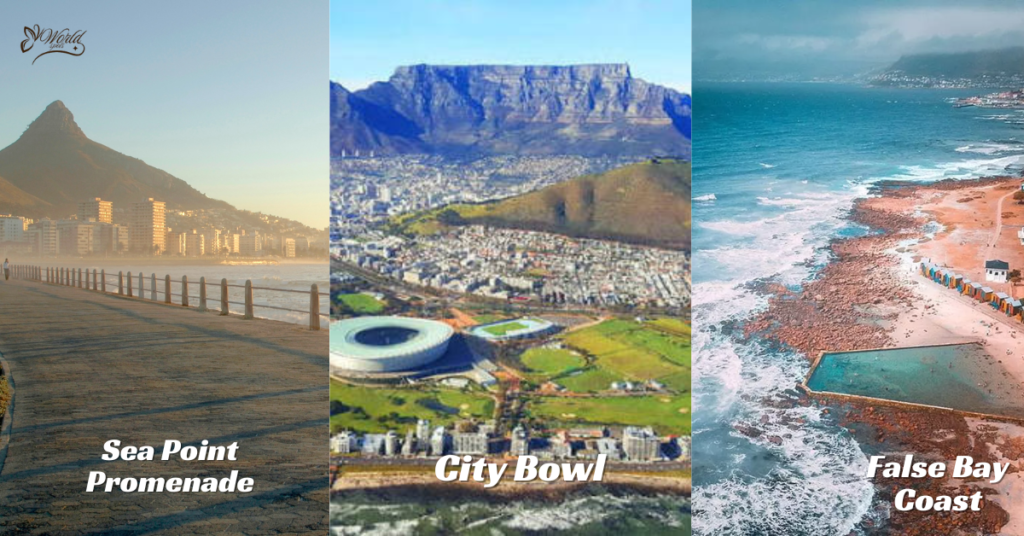
Cape Town neighbourhoods: Sea Point Promenade, City Bowl and the False Bay coast

1- Atlantic Seaboard

Sea Point and Green Point

Sea Point is popular with young professionals and remote workers. You get the 11 km Sea Point Promenade for morning runs, cafés on every corner, good public transport, and quick access to the city centre. Green Point next door offers the stadium park and easy Waterfront access.

Good for: walkability, ocean views, an active lifestyle.

2- City Bowl

Gardens, Tamboerskloof, and Oranjezicht

These leafy suburbs sit right under Table Mountain. Expect Victorian houses, trendy restaurants along Kloof Street, and hiking trails on your doorstep. The Oranjezicht City Farm Market on Saturdays is a local favourite.

Good for: couples, creatives, and anyone who wants city living with mountain access.

3- Southern Suburbs

Rondebosch, Newlands, and Claremont

Greener, quieter, and close to top schools and the University of Cape Town. Newlands is famous for its rugby and cricket stadiums and its forest walks.

Good for: families and students.

4- False Bay Coast

Muizenberg and Kalk Bay

Laid-back seaside villages with a strong community feel, warmer water than the Atlantic side, and a slower pace of life. They are further from the city centre (about 30–40 minutes by car), but many people find the trade-off worth it.

Good for: surfers, artists, and people who want a village lifestyle

Best Time to Visit Cape Town

SeasonMonthsWhat to Expect
SummerDec–FebHot, dry, busy; strong “Cape Doctor” south-easterly wind
AutumnMar–MayWarm days, fewer crowds; the sweet spot
WinterJun–AugCool and rainy; low prices; whale season begins
SpringSep–NovWildflowers on the West Coast, whales in False Bay

For beaches and hiking, aim for November to April. For lower prices and whale sightings, consider September or October.

How to Get Around Cape Town

  • Uber and Bolt: affordable, widely available, and the easiest option for most visitors.
  • MyCiTi bus: a reliable public bus network covering the city, Atlantic Seaboard, and airport.
  • Hop-on hop-off bus: convenient for first-timers, with routes covering the main attractions.
  • Car rental: the best choice for the Cape Peninsula and Winelands. Remember, South Africans drive on the left.

Safety tip: Like any big city, Cape Town requires common sense. Do not walk alone at night in quiet areas, keep valuables out of sight, and hike popular trails in groups during daylight.

3-Day Cape Town Travel Plans

Day 1: City and Mountains

  • Morning: Table Mountain (cable car or hike)
  • Afternoon: Bo-Kaap and Company’s Garden
  • Evening: Sunset at Signal Hill, dinner at the V&A Waterfront

Day 2: Cape Peninsula Road Trip

  • Morning: Chapman’s Peak Drive via Hout Bay
  • Midday: Cape Point and the Cape of Good Hope
  • Afternoon: Penguins at Boulders Beach
  • Evening: Seafood in Kalk Bay

Day 3: Gardens, Wine, and History

  • Morning: Robben Island tour
  • Afternoon: Kirstenbosch Gardens, then wine tasting in Constantia
  • Evening: Sunset walk on the Sea Point Promenade

Frequently Asked Questions About Places to Visit in Cape Town

What is the number one place to visit in Cape Town?

Table Mountain is the top attraction in Cape Town. Take the cable car or hike up for panoramic views over the city, Robben Island, and both coastlines.

How many days do you need in Cape Town?

Three days cover the highlights: the city, the Cape Peninsula, and Robben Island or the Winelands. With 5 to 7 days, you can add day trips to Stellenbosch, Franschhoek, or Hermanus without rushing.

What are the best free places to visit in Cape Town?

Lion’s Head, Signal Hill, Bo-Kaap, Company’s Garden, the Sea Point Promenade, Camps Bay, Muizenberg, and Kalk Bay are all free to visit.

Is Cape Town safe for tourists?

Cape Town is generally safe in tourist areas such as the V&A Waterfront, City Bowl, and Atlantic Seaboard if you take normal big-city precautions. Use Uber at night, avoid isolated areas, and hike in groups.

Can you swim at Cape Town beaches?

Yes, but the Atlantic side (Camps Bay, Clifton) is very cold. For warmer water, head to False Bay beaches such as Muizenberg, St James, and Boulders.

What is the best area to stay in Cape Town for first-time visitors?

The V&A Waterfront and the City Bowl are the best choices for first-timers because they are central, walkable, and close to most major attractions.

Where is the best place to see penguins in Cape Town?

Boulders Beach in Simon’s Town is the best place to see African penguins. Stony Point in Betty’s Bay is a quieter alternative about 1.5 hours away.

Final Thoughts: Start Planning Your Cape Town Trip

From the summit of Table Mountain to the penguins of Boulders Beach and the wine cellars of Constantia, the places to visit in Cape Town offer a mix of nature, history, and culture that few cities in the world can match.

Start with the icons, leave room for at least one hidden gem, and always keep a flexible weather day in your plan. Cape Town rewards travellers who slow down.

Best Places to Visit in Africa: 22 Destinations Worth Every Mile (2026 Guide)

0

Africa isn’t one trip; it’s fifty-four countries, a dozen ecosystems, and more “best places” than any single holiday could hold. That’s exactly why so many people freeze at the planning stage. Do you chase the Great Migration in East Africa, sip wine below Table Mountain, drift over red dunes in Namibia, or lose yourself in a blue-washed Moroccan medina?

This guide cuts through that overwhelm. Instead of a random list of attractions, we’ve organised the best places to visit in Africa the way you’d actually plan a route: region by region, country by country, pairing each destination with the one thing it does better than anywhere else. You’ll also get the practical layer most guides skip: when to go, what a trip really costs, how to combine destinations, and honest answers to the questions first-timers always ask.

Whether you’re booking your first safari or hunting for somewhere the crowds haven’t found yet, start here.

How to Choose Where to Go in Africa

Africa is roughly the size of the USA, China, India, and most of Europe combined, so “where should I go” is really five smaller questions. It helps to think of the continent in five travel zones, each with its own signature experience:

  • East Africa: classic safari country and tropical islands (Kenya, Tanzania, Uganda, Rwanda).
  • Southern Africa: the most beginner-friendly mix of safari, wine, coast, and desert (South Africa, Botswana, Namibia, Zambia, Zimbabwe, Mozambique).
  • North Africa: ancient history, medinas, mountains, and desert (Morocco, Egypt, Tunisia).
  • West Africa: culture, music, and off-the-radar coastline (Senegal, Ghana, The Gambia).
  • Islands & offbeat gems for travellers who want to leave fewer footprints (Zanzibar, São Tomé, Madagascar, the DRC’s volcanoes).

Best Places to Visit in Africa at a Glance

DestinationCountryBest forIdeal months
Masai MaraKenyaGreat Migration, big catsJul–Oct
Serengeti & NgorongoroTanzaniaIconic safari, crater floorJun–Oct
ZanzibarTanzaniaBeaches, Stone TownJun–Oct
Bwindi ForestUgandaGorilla trekking (best value)Jun–Sep
Volcanoes NPRwandaGorillas, easy accessJun–Sep
Cape TownSouth AfricaCity + coast + wineNov–Mar
Kruger NPSouth AfricaBig Five on a budgetMay–Sep
Okavango DeltaBotswanaWater safari, exclusivityJul–Oct
Victoria FallsZambia/ZimbabweThe waterfall + adrenalineFeb–May (full flow)
SossusvleiNamibiaRed dunes, desertMay–Oct
Marrakech & AtlasMoroccoMedinas, mountainsMar–May, Sep–Nov
Pyramids & NileEgyptAncient historyOct–Apr

Best Places to Visit in East Africa

East Africa is where the safari archetype was born; endless savannah, big cats, and the largest overland animal migration on earth. It’s also home to some of the continent’s best beaches once you’re done in the bush.

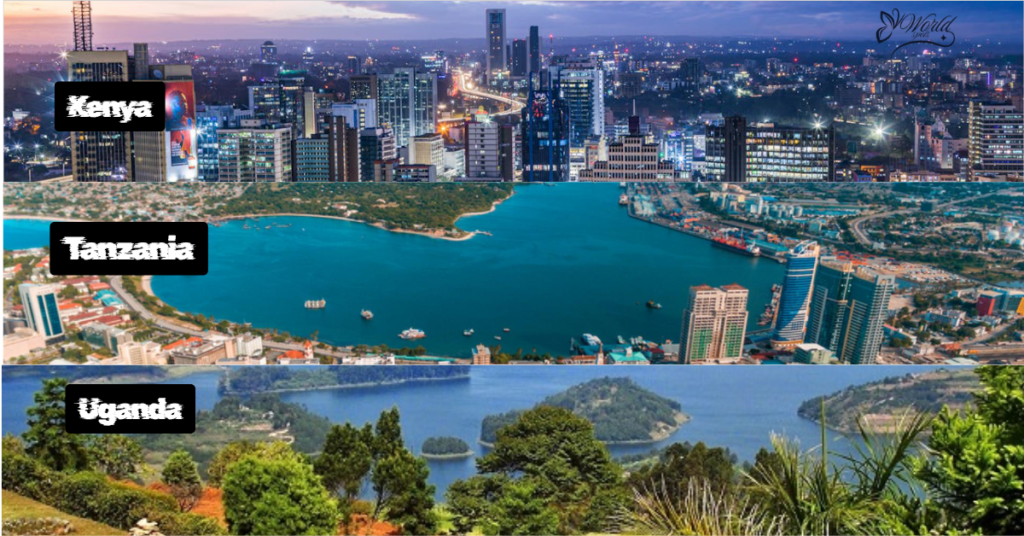
Best places to visit in East Africa: Kenya, Tanzania and Uganda
  1. Masai Mara, Kenya

If you only see one safari destination in Africa, make it the Mara. This rolling grassland is the northern extension of the Serengeti and delivers the highest density of big cats on the continent; lions, cheetahs, and leopards are near-daily sightings. Between roughly July and October, it becomes the stage for the Great Migration river crossings, when hundreds of thousands of wildebeest brave the crocodile-filled Mara River.

Because the reserve is compact, it feels accessible and rewarding even on a short trip. For fewer vehicles at each sighting, base yourself in one of the surrounding private conservancies, where off-road driving and night drives are permitted.

  1. Serengeti & Ngorongoro Crater, Tanzania

The Serengeti is the Mara’s vast southern sibling; 30,000 square kilometres of plains where the migration spends most of the year. Time your visit to the calving season (roughly January to March) in the southern Serengeti, and you’ll witness predators shadowing thousands of newborn wildebeest.

An hour’s drive away, the Ngorongoro Crater is a natural amphitheatre: a collapsed volcanic caldera whose walls trap an entire ecosystem, including one of your best chances in Africa to see a black rhino. The two together make an unbeatable first-timer combination.

  1. Zanzibar, Tanzania

After the dust of a safari, Zanzibar is the reward. This spice island in the Indian Ocean pairs powder-white beaches on its east coast with the labyrinthine, UNESCO-listed alleys of Stone Town; a heady mix of Swahili, Arab, Indian, and European history.

Spend your mornings snorkelling or kite-surfing at Paje and Nungwi, and your evenings wandering to the Forodhani night market for grilled seafood. It’s the classic “safari and beach” second leg, and only a short flight from the mainland parks.

  1. Bwindi Impenetrable Forest, Uganda

Coming face to face with a wild mountain gorilla is, for many travellers, the single most moving hour they’ll ever spend outdoors. Uganda’s Bwindi Impenetrable Forest shelters roughly half the world’s remaining mountain gorillas, and it’s the most affordable, and arguably safest, place to trek to them.

The hike through dense, dripping forest can be tough, but the payoff- sitting metres from a silverback and his family- is unforgettable. Uganda pairs beautifully with a chimp-tracking add-on in Kibale.

  1. Volcanoes National Park, Rwanda

Rwanda offers the same gorilla magic as Uganda with far less travel time; the park is only a couple of hours from the clean, safe capital of Kigali, which makes it ideal if you’re short on days. Permits cost more here, but the convenience and Rwanda’s remarkable post-genocide transformation into one of Africa’s safest, most orderly countries make it a compelling choice.

Add a sobering but essential visit to the Kigali Genocide Memorial to understand the country you’re travelling through.

Best Places to Visit in Southern Africa

Southern Africa is the easiest region for first-timers: self-drive-friendly, malaria-free options, excellent roads and lodges, and an unmatched variety of experiences within a single trip.

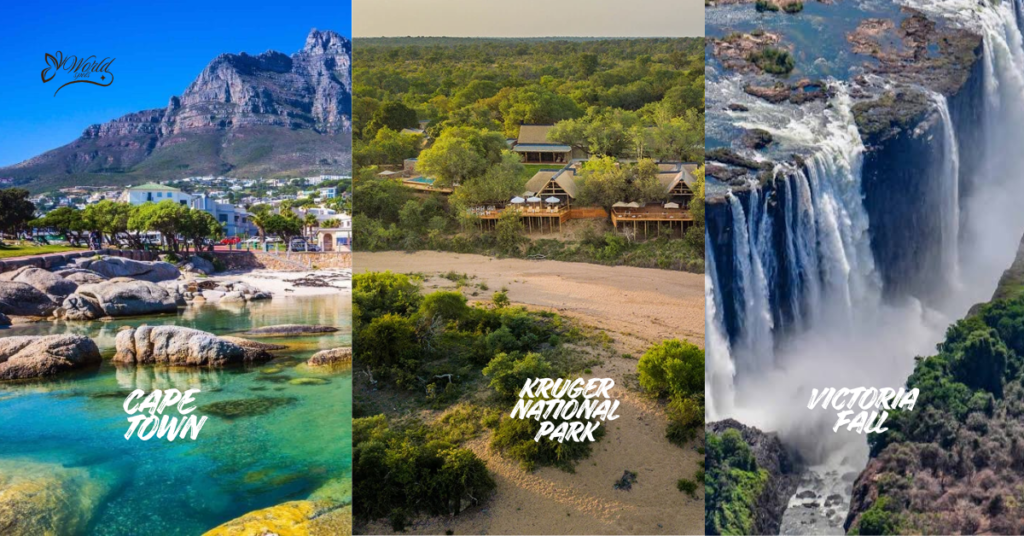
Southern Africa highlights: Cape Town, Kruger National Park and Victoria Falls
  1. Cape Town, South Africa

Few cities on earth have a setting like Cape Town, where a flat-topped mountain rises straight out of the sea between two oceans. It routinely lands on “best city in the world” lists, and once you’ve been, you understand why.

Table Mountain

Take the rotating cable car up, or hike the Platteklip Gorge trail if you’re fit; for a view over the city bowl, the Cape Peninsula, and Robben Island, where Nelson Mandela was imprisoned.

The Cape Winelands

Just 45 minutes inland, Stellenbosch and Franschhoek offer world-class wine estates framed by dramatic mountains; one of the most relaxed and affordable fine-dining experiences anywhere in Africa.

  1. Kruger National Park, South Africa

Kruger is the most accessible Big Five safari in Africa and the best value for money. You can self-drive its excellent road network on a tight budget, or splurge on a luxury private concession like Sabi Sands on its western edge, where off-road tracking makes leopard sightings almost routine. It’s a superb choice for families and first-timers who want flexibility.

  1. Okavango Delta, Botswana

The Okavango is one of the planet’s great natural wonders; a river that never reaches the sea, instead fanning out into a maze of channels and islands in the Kalahari. Here you safari by mokoro (a traditional dugout canoe), gliding silently past elephants and hippos. Botswana’s high-value, low-impact tourism model keeps crowds thin and exclusivity high, so it’s a splurge; but a peerless one.

  1. Victoria Falls, Zambia & Zimbabwe

Straddling the border of Zambia and Zimbabwe, “the smoke that thunders” is one of the Seven Natural Wonders of the World; a curtain of water more than a kilometre wide. View it on foot from either side (Zimbabwe offers panoramic views; Zambia gets you closer), fly over it by helicopter, or, when water levels are low, swim to the very lip of Devil’s Pool. Adrenaline junkies can bungee off the bridge between the two countries.

  1. Sossusvlei & the Namib Desert, Namibia

Namibia is a photographer’s dream and one of Africa’s most underrated destinations. At Sossusvlei, some of the tallest dunes on earth glow burnt-orange at sunrise above the ghostly white clay pan of Deadvlei, studded with 900-year-old blackened trees. The wider country delivers desert-adapted elephants, the eerie Skeleton Coast, and the adventure hub of Swakopmund. It’s tailor-made for a self-drive road trip.

  1. Bazaruto Archipelago, Mozambique

For an Indian Ocean paradise with barely another tourist in sight, Mozambique’s Bazaruto Archipelago is hard to beat; sandbanks and turquoise shallows where you can dive, snorkel with whale sharks in season, and sail a traditional dhow at sunset. It’s the ideal beach finale to a Kruger or Botswana safari.

Best Places to Visit in North Africa

North Africa trades savannah for medinas, mountains, and millennia of history. It’s a completely different Africa, and one of the most rewarding for culture lovers.

  1. Marrakech & the Atlas Mountains, Morocco

Marrakech is a full-body sensory experience: the snake charmers and food stalls of Jemaa el-Fnaa square, the hush of hidden riad courtyards, the colour of the Majorelle Garden. Use it as a base to escape into the snow-dusted High Atlas Mountains for Berber village treks, or push south to camel-trek into the Sahara and sleep under the stars at Erg Chebbi.

  1. Chefchaouen, Morocco

Tucked into the Rif Mountains, Chefchaouen is the famous “Blue City,” where every wall, stair, and doorway is washed in shades of indigo. It’s smaller and calmer than Marrakech, endlessly photogenic, and a perfect slow-travel counterpoint on a wider Morocco loop.

  1. The Pyramids of Giza & Cairo, Egypt

The last surviving Wonder of the Ancient World still stops you in your tracks. Standing before the Great Pyramid and the Sphinx on the edge of Cairo is a genuine bucket-list moment, made richer by the treasures of the new Grand Egyptian Museum nearby. Cairo is chaotic, ancient, and utterly unforgettable.

  1. Luxor & the Nile, Egypt

Often called the world’s greatest open-air museum, Luxor holds the Valley of the Kings, the vast Karnak Temple, and Luxor Temple, best seen illuminated after dark. The classic way to experience it is a multi-day Nile cruise between Luxor and Aswan, watching temples and timeless riverbank life drift past from the deck.

Best Places to Visit in West Africa

West Africa is the continent at its most vibrant and least touristy; a region for travellers drawn to music, culture, and warm welcomes rather than checklists.

  1. Dakar & Gorée Island, Senegal

Senegal is one of West Africa’s most stable and accessible countries, and Dakar pulses with music, art, and Atlantic energy. A short ferry away, Gorée Island offers a moving, essential reckoning with the history of the transatlantic slave trade, while the colonial-era streets of Saint-Louis further north brim with faded character.

  1. The Gambia

Tiny, English-speaking, and famed for its birdlife and beaches, The Gambia is West Africa’s gentlest introduction. River cruises, community-run eco-lodges, and wildlife sanctuaries make it a low-stress, high-reward destination that most travellers overlook entirely.

Underrated & Offbeat Places to Visit in Africa

Ready to trade the crowds for something rarer? These destinations reward the more adventurous traveller with experiences you simply can’t get on the classic circuit.

  1. Lalibela, Ethiopia

In the Ethiopian highlands stand eleven medieval churches carved downward out of solid rock; a living pilgrimage site where white-robed worshippers still fill the incense-thick chambers at dawn. Ethiopia, the only African nation never colonised, offers a culture unlike anywhere else on the continent, from Lalibela to the colourful walled city of Harar.

  1. South Luangwa National Park, Zambia

The birthplace of the walking safari, South Luangwa delivers one of Africa’s most authentic bush experiences with a fraction of the crowds. Leopard sightings are exceptional, and night drives reveal a whole nocturnal cast the day-trippers never meet.

  1. Damaraland, Namibia

An otherworldly landscape of ancient rock art, red-rock mountains, and rare desert-adapted elephants and black rhinos that have learned to survive with almost no water. Damaraland feels genuinely wild and remote in a way the big-name parks rarely do.

  1. Mount Nyiragongo, DR Congo

For hardened adventurers only: a strenuous trek up an active volcano to camp on the rim above the largest lava lake in the world, glowing and churning far below through the night. Conditions and safety vary, so it requires careful, up-to-date planning; but few experiences on earth compare.

  1. São Tomé & Príncipe

A pair of lushly forested volcanic islands in the Gulf of Guinea, with empty beaches, cocoa plantations, and a laid-back Creole culture. One of Africa’s least-visited countries; perfect for travellers who want to genuinely disconnect.

Best Places to Visit in Africa by Travel Style

Still narrowing it down? Here’s the quick-pick version by what matters most to you.

Best for a First Safari

Choose Kruger (South Africa) for value and flexibility, or the Masai Mara (Kenya) and Serengeti (Tanzania) for sheer big-cat and migration drama. All three are reliable, well-serviced, and hard to get wrong.

Best for Beaches

Zanzibar and Bazaruto (Mozambique) for the classic Indian Ocean dream; the Seychelles for luxury; São Tomé for total seclusion.

Best for Culture & History

Egypt for ancient wonders, Morocco for living medinas, Ethiopia for something found nowhere else, and Senegal for West African depth.

Best for Adventure

Victoria Falls for adrenaline, Namibia for desert self-drives, Uganda/Rwanda for gorilla treks, and the DRC for volcano climbing.

Best for Budget Travel

South Africa offers the most for your money (self-drive Kruger, cheap wine country), while Uganda delivers gorillas cheaper than its neighbours and Egypt packs huge history into a low daily budget.

Best Time to Visit Africa, Region by Region

Because the continent spans both hemispheres, there’s no single “best” month; it depends entirely on where you’re headed.

  1. East Africa

The long dry season (roughly June–October) is prime safari time: animals cluster around water and the migration river crossings peak in the Mara from July. The short rains around November green everything up and cut prices.

  1. Southern Africa

For safari (Kruger, Botswana, Zambia), the dry winter (May–October) offers the best wildlife viewing. For Cape Town and the coast, flip that; the summer (November–March) brings the beach and wine-country weather.

  1. North Africa

Aim for spring (March–May) or autumn (September–November) to dodge the fierce summer heat while sightseeing in Morocco and Egypt. For Egypt specifically, the cooler October–April window is ideal.

  1. West Africa

The dry season (roughly December–February) brings the lowest humidity and rainfall; the most comfortable time to explore Senegal, Ghana, and The Gambia.

How Much Does a Trip to Africa Cost?

Africa spans every budget, but costs vary enormously by style and region. As a rough planning guide (excluding international flights, per person per day):

  • Budget (self-drive South Africa, Egypt, backpacking Uganda): from around $50–120/day.
  • Mid-range (comfortable lodges, guided Kenya/Tanzania safaris): roughly $250–500/day.
  • Luxury (Botswana, private conservancies, fly-in camps): $800–1,500+/day.

Gorilla permits are a major fixed cost (Rwanda and Uganda charge premium rates), and safari lodges are almost always all-inclusive, which softens the sticker shock. Beach add-ons like Zanzibar can be surprisingly affordable, while private islands are the opposite.

Practical Tips for Visiting Africa

A few things worth knowing before you book:

  • Safety: Africa is a continent, not a country; security varies hugely between (and within) nations. Check current, region-specific government travel advisories rather than relying on broad reputations. Most classic tourist destinations are very safe.
  • Visas: Many countries offer visa-on-arrival or e-visas; Kenya, Tanzania, and others have simplified this in recent years. Confirm requirements for your passport before travelling.
  • Health: Malaria prophylaxis is advised for many safari regions (though areas like Cape Town and parts of Namibia are malaria-free). Yellow fever vaccination is required for entry to some countries. See a travel clinic 6–8 weeks ahead.
  • Getting around: Southern Africa is excellent for self-drive; East Africa is usually done via guided safari; regional flights save days on longer multi-country trips.
  • Money: Carry some US dollars for permits and tips, but a low-fee travel card covers most day-to-day spending.

How to Combine Destinations: Sample Routes

The smartest African trips pair a safari with a contrasting second experience. A few field-tested combinations:

Two Weeks in East Africa

Masai Mara (Kenya) → Serengeti & Ngorongoro (Tanzania) → wind down on the beaches of Zanzibar. The definitive first-timer safari-and-beach loop.

Two Weeks in Southern Africa

Cape Town & the Winelands → the Garden Route → a Kruger safari → finish on the sands of Mozambique. Malaria-free options throughout much of it, and mostly self-drive.

Ten Days in Morocco

Marrakech → the High Atlas → a Sahara desert night → the Blue City of Chefchaouen → coastal Essaouira. All overland, no domestic flights needed.

Frequently Asked Questions

What is the best place to visit in Africa for first-timers?

For a first trip, it’s hard to beat South Africa (Cape Town plus a Kruger safari) or the classic Kenya–Tanzania safari circuit. All offer world-class wildlife, strong tourism infrastructure, and an easy mix of experiences in one holiday.

Which African country is safest for tourists?

Countries like Rwanda, Botswana, Namibia, and Mauritius are consistently regarded as very safe for travellers, with popular tourist areas in South Africa, Kenya, Tanzania, Morocco, and Egypt also well-equipped for visitors. Safety varies by region, so always check current advisories.

What is the cheapest African country to visit?

Egypt offers extraordinary value for history lovers, while South Africa stretches a budget furthest for a safari trip thanks to self-drive options and an affordable exchange rate. Uganda is the best-value place to see mountain gorillas.

When is the best time to visit Africa for a safari?

The dry season is best for wildlife viewing; roughly June to October in both East and Southern Africa, when thinner vegetation and water-dependent animals make game easier to spot.

Do I need vaccinations to visit Africa?

Requirements vary by country. Yellow fever vaccination is mandatory for some destinations, and malaria prevention is recommended for many safari areas. Consult a travel health clinic well before departure for advice specific to your itinerary.

Start Planning Your African Adventure

The “best place to visit in Africa” isn’t a single destination; it’s the one that matches the trip you want. Chase the migration in the Mara, drift through the Okavango, lose track of time in a Moroccan medina, or find an island with your name on it. Pick your region, lock in the right season, and let the rest fall into place.

Bookmark this guide as your starting point, and dive into the detailed destination guides linked throughout as you build your route.

Best Sunset Spots in San Francisco: A Guide to Where (and When) the Sky Lights Up

0

San Francisco is a compact, hilly city on the northern tip of a peninsula in Northern California, America, wrapped by the Pacific Ocean and San Francisco Bay. Famous for the Golden Gate Bridge, rattling cable cars, steep streets, and the fog locals nickname “Karl,” it packs enormous variety into just 47 square miles. It’s a hub of tech and innovation anchored by nearby Silicon Valley. Cool, breezy summers and mild winters give it a temperate, year-round climate that rarely sees extremes; distinctly, unmistakably San Francisco.

Ask ten San Franciscans where the best sunset spots in San Francisco are, and you’ll get eleven answers; because in a city built on hills, wrapped by the Pacific on three sides, and famous for a fog with its own name, the “best” spot changes with the season, the weather, and whether you want the Golden Gate Bridge in your photo.

This guide cuts through that. Below you’ll find the viewpoints locals actually return to, the beaches that deliver when the fog stays away, month-by-month sunset times so you never miss the light, and even a few spots beyond the city limits for when you want something quieter. Grab a jacket (you’ll need it), and let’s chase some color.

What Makes San Francisco Sunsets So Special (Meet Karl the Fog)

San Francisco’s geography does the heavy lifting. The city sits on a peninsula surrounded by water on three sides, with a spine of hills running down the middle. That means almost anywhere with a bit of elevation gives you a wide, west-facing view; perfect for watching the sun drop into the ocean.

Then there’s the fog. Locals have affectionately named it Karl the Fog, and Karl is the single biggest variable in your sunset plans. When the fog rolls in low and thin, it catches the light and turns the sky into that signature pink-and-orange wash the city is known for. When it rolls in thick, which it often does on summer evenings, it swallows the view entirely and leaves you staring at a wall of grey.

The rule every local lives by: before you head out, glance west toward the ocean. If you see a low bank of fog creeping in, pivot to an inland or elevated spot like Twin Peaks or Corona Heights, which sit above or behind the fog line. Save the beach for genuinely clear evenings.

  • Quick tip: The clearest, warmest evenings in San Francisco usually come in September and October, not summer. If you’re planning a trip specifically to catch a great sunset, autumn is your best bet.

What Reddit Says Are the Best Sunset Spots in San Francisco?

Search “best sunset San Francisco” on Reddit and a few names come up again and again in threads on r/sanfrancisco and r/bayarea. Locals, the people watching these sunsets week in, week out, tend to agree on a short list, and it’s worth knowing before you plan your evening:

  • Twin Peaks is the near-universal recommendation for first-timers who want the classic 360-degree city view.
  • Corona Heights gets loved for the same skyline view as Twin Peaks but with a fraction of the crowds.
  • Bernal Heights Park is the local favorite for a relaxed, dog-friendly hill with a straight shot at downtown.
  • Baker Beach wins every “best Golden Gate Bridge sunset” thread.
  • Lands End and Battery Spencer dominate the “most dramatic / most photogenic” conversations.

The Best Sunset Spots in San Francisco

Here are the viewpoints inside the city that consistently deliver. Beaches have their own dedicated sections further down, so this list focuses on the hills, parks, and rooftops where you’ll get elevation and skyline views.

Sunset over the San Francisco skyline
  1. Twin Peaks

Twin Peaks is the most iconic sunset viewpoint in San Francisco, and for good reason. From roughly 900 feet up near the geographic center of the city, you get a genuine 360-degree panorama: the ocean and the Golden Gate Bridge to the west and north, the downtown skyline and the East Bay to the east.

It’s the spot to bring first-time visitors. Just know that it’s windy year-round (yes, even in summer), and it draws crowds on clear evenings. How to get there and what to know

  • Access: Easy. Drive right up to the parking lot near the summit, or park lower and walk up.
  • Best for: First-timers, panoramic photos, that “wow” moment.
  • Pro tip: Look east as the sun sets behind you; the skyline turns gold, and the city lights flicker on as twilight settles.
  1. Corona Heights Park

If Twin Peaks feels too busy, Corona Heights is the local’s alternative. A short but steep climb up its rocky red outcrop rewards you with a wide-open view of downtown, the Bay, and the East Bay hills minus the tour buses. It’s a favorite among photographers and dog walkers, and the exposed rock at the top makes a great perch for the show.

  1. Lands End & Sutro Baths

On the wild northwestern edge of the city, Lands End is San Francisco at its most dramatic. A cliffside trail traces an old rail line above the crashing Pacific, opening onto sweeping views of the Golden Gate Bridge. At the trailhead sit the haunting ruins of the Sutro Baths; the concrete bones of what was once the world’s largest indoor swimming complex before a 1966 fire.

Winter often brings the most striking, hazy sunsets here. Wear sturdy shoes; the path is gorgeous but uneven. How to get there and what to know

  • Access: Moderate. Trails are uneven and steep in sections; not stroller-friendly.
  • Best for: Hikers, photographers, history buffs.
  • Pro tip: Budget 60–90 minutes to explore the Sutro Baths ruins and the hidden stone labyrinth near the point.
  1. Grand View Park (Turtle Hill)

Tucked in the Sunset District, Grand View Park delivers nearly the same 360-degree view as Twin Peaks with a fraction of the crowds. A short climb up sand ladders and a dirt path gets you to the top, where you’ll see the colorful rows of Sunset District houses, Golden Gate Park, and the ocean beyond. Pair it with the famous 16th Avenue Tiled Steps at its base for a double dose of local magic.

  1. Bernal Heights Park

Bernal Heights is basically a giant grassy hill crowning its namesake neighborhood, and it’s one of the most relaxed sunset spots in the city. You’ll get a clean view of the downtown skyline, Twin Peaks, and the Bay, and you’ll be surrounded by locals walking their dogs and spreading out picnic blankets. Because it sits well east of Twin Peaks, the sun actually dips below the horizon a touch earlier than the official time, so arrive with margin.

  1. Cityscape Lounge (For a Sunset With a Cocktail)

Prefer your sunset with a drink in hand and zero walking? Cityscape Lounge sits on the 46th floor of the Hilton near Union Square, offering 360-degree views through floor-to-ceiling windows. It’s the go-to when Karl the Fog wins outside; you’re warm, indoors, and still above the weather. Come about 30 minutes before sunset and stay through twilight to watch the city light up.

Ocean Beach: San Francisco’s Longest Sunset Stretch

Orange sunset over the ocean with palm tree silhouettes

Running the entire western edge of the city, Ocean Beach is the longest and widest beach in San Francisco; over three miles of sand spanning the Sunset and Richmond districts. That size is its superpower: there’s always room to find your own patch of sand to watch the sun sink straight into the Pacific.

Ocean Beach is also one of the few spots where bonfires are allowed in designated fire pits (no permit needed; just check current city rules before you go). On a rare warm, clear evening, nothing beats a beach fire and the sunset over the waves.

How to get there and what to know

  • Access: Easy. A few steps down and you’re on the sand.
  • Best for: Families, dogs, bonfires, and space to spread out.
  • Watch for: Fog. Ocean Beach is the first place Karl hits as it rolls off the Pacific, so this is a clear-evening spot. Dress in layers; it’s chilly here most of the year.
  • Pro tip: Climb one of the dunes near Lincoln Way for a slightly elevated view, and grab dinner afterward along Judah or Irving streets in the Outer Sunset, five minutes away.

Best Sunset Spots in the Bay Area (Beyond the City)

Some of the most jaw-dropping sunset views of San Francisco aren’t in San Francisco at all; they’re across the water. If you have a car and a little extra time, these Bay Area sunset spots are worth the drive.

  1. Battery Spencer (Marin Headlands)

Just across the Golden Gate Bridge in the Marin Headlands, Battery Spencer offers what many consider the single best view of the bridge and the city skyline behind it. You’re looking straight down the length of the Golden Gate with the whole city glittering beyond. It’s a top pick for proposals and photographers alike, and it gets extremely windy, so bring a jacket and a hair tie.

  1. Hawk Hill

A little further up Conzelman Road from Battery Spencer, Hawk Hill trades a slightly smaller bridge for far fewer people. If Battery Spencer is packed, this is your quieter alternative with a wider ocean-and-lighthouse view.

  1. Treasure Island

The man-made Treasure Island, sitting midway between San Francisco and Oakland, gives you the best unobstructed view of the Bay Bridge and the downtown skyline. Photographers set up tripods along the Avenue of the Palms regularly, so arrive early for a clear spot.

  1. Farther Afield: Mount Tamalpais & Pacifica

For a true escape, Mount Tamalpais in Marin rises high above the fog line with views that stretch across the entire Bay Area on clear days. South of the city, the beaches of Pacifica offer wide-open Pacific sunsets with a laid-back surf-town feel. Both are worth a dedicated evening.

Baker Beach: The Classic Golden Gate Bridge Sunset

Golden Gate Bridge at sunset seen from Baker Beach, San Francisco

If there’s one photo everyone wants from San Francisco, it’s the Golden Gate Bridge glowing at sunset with a beach in the foreground; and Baker Beach is where you get it. Set on the city’s northwestern edge in the Presidio, this beach faces the Marin Headlands and gives you a direct, unobstructed line to the bridge.

The Baker Beach sunset is one of the most accessible in the city: there’s a large parking lot and no hiking required to reach the sand. The north end of the beach has the best bridge angle, so walk toward the bridge as the light drops. For photographers, the neighboring Marshall’s Beach (a short hike down the bluff) is the classic hidden-gem angle; quieter, and framed even more dramatically.

How to get there and what to know

  • Access: Easy to moderate. Big parking lot, short walk down to the sand.
  • Best for: Photographers and first-timers chasing the classic bridge shot.
  • Pro tip: Parking fills fast on clear evenings; arrive at least an hour before sunset. And skip it entirely if the fog is in; you literally won’t see the bridge.

Where to Watch the Sunrise in San Francisco

Sunsets get the glory, but sunrise in San Francisco has a quiet magic of its own; softer light, empty viewpoints, and a golden glow behind the Golden Gate Bridge. If you’re an early riser (or just jet-lagged into an early wake-up), these are the spots to catch it:

  • Battery Spencer & Kirby Cove (Marin): The sun rises behind the Golden Gate Bridge from here, backlighting it in gold. This is the money shot for sunrise photographers.
  • Twin Peaks: The same panorama as sunset, but with the sky lighting up over the East Bay and downtown, and almost no one around.
  • Mount Davidson: The highest point in the city, and a local favorite for watching the fog glow as the sun rises over its eucalyptus forest.
  • Bernal Heights & Corona Heights: Both face east, making them natural sunrise perches over the skyline.

A note on timing: in San Francisco, the earliest sunrises come in mid-June (around 5:47 AM), while the latest are at the end of October (around 7:35 AM). Check the table below to plan your alarm.

San Francisco Sunset Times by Month

Timing is everything with sunsets; arrive 30 minutes early to settle in and catch the pre-sunset “golden hour” glow. San Francisco’s sunset time swings by nearly four hours across the year, and the clocks jump an hour in early March and early November for daylight saving time. Here’s a month-by-month guide to San Francisco sunset times (approximate, based on the middle of each month):

MonthApprox. Sunset TimeNotes
January5:15 PMShort days; earliest sunsets of the year in early December carry over
February5:45 PMDays noticeably lengthening
March7:15 PMClocks spring forward March 8 ; sunset jumps an hour
April7:40 PMMild evenings, longer light
May8:05 PMLate sunsets begin
June8:30 PMLatest sunsets of the year (up to ~8:35 PM near the solstice)
July8:20 PMLong days, but prime “Karl the Fog” season
August7:55 PMStill long evenings; fog common at the coast
September7:10 PMClearest, warmest sunsets of the year
October6:25 PMExcellent light; latest sunrises of the year here too
November5:00 PMClocks fall back November 1; sunset drops an hour
December4:55 PMEarliest sunsets (~4:52 PM around Dec 6–7)

Crissy Field: Sunset at the Foot of the Golden Gate

Between the Marina and the Golden Gate Bridge, Crissy Field is a former airfield turned waterfront park, and one of the most relaxed sunset spots in San Francisco. Grassy fields give way to a beach and a tidal marsh that mirrors the sky, with the Golden Gate Bridge framed perfectly to the west.

The Crissy Field sunset is a local favorite because it’s flat, free, easy to reach, and endlessly walkable. Stroll the promenade past the sailboats and the quirky Wave Organ, and keep going toward Fort Point; the old brick fort tucked directly beneath the bridge, where you can stand right at the base of that iconic span as the sun goes down.

How to get there and what to know

  • Access: Easy. Flat, paved paths; great for strollers, bikes, and wheelchairs.
  • Best for: Families, walkers, and anyone who wants the bridge without a hike.
  • Pro tip: Walk west toward Fort Point for the most dramatic bridge-and-sunset angle, then loop back as the city lights come on.

Best Sunset Spots in San Jose

Heading to the South Bay? San Jose and the surrounding hills have their own excellent sunset viewpoints; handy if you’re based in Silicon Valley and don’t want the drive up to the city. The best sunset spots in San Jose trade ocean views for sweeping valley-and-city panoramas:

  • Communications Hill: A famous staircase climb rewards you with a wide view over the San Jose skyline and the whole valley; a local sunset ritual.
  • Alum Rock Park: The oldest municipal park in California, set in the eastern foothills with trails and elevated overlooks that glow at golden hour.
  • Sierra Vista Open Space Preserve: Higher into the hills, with expansive views across the South Bay all the way toward the peninsula on clear evenings.
  • Ford Road / Quimby Road overlooks: Roadside pullouts in the eastern hills that locals use for quick, spectacular valley sunsets.

For a coastal option, it’s about an hour’s drive over the hills to Santa Cruz, where the Pacific delivers the beach sunset the South Bay lacks.

Practical Tips for the Perfect San Francisco Sunset

A few hard-won rules to make sure your evening pays off:

  • Dress warmer than you think. This isn’t Southern California. Once the sun drops, temperatures fall fast, especially by the water and up on the hills. Bring a jacket and a beanie in winter.
  • Always arrive early. Aim for 30–45 minutes before sunset. Parking at popular spots (Baker Beach, Battery Spencer, Twin Peaks) fills up fast on clear evenings, and the pre-sunset golden hour is often the most beautiful part.
  • Stay past the sunset. The best color frequently comes in the 10–20 minutes after the sun dips, during twilight, when the sky deepens, and the city lights switch on.
  • Check the fog forecast. If a low fog bank is sitting over the ocean, choose an inland/elevated spot or an indoor rooftop bar instead of the coast.
  • Go on a weekday if you want the marquee spots without the crowds.

Frequently Asked Questions

Where is the best place to watch the sunset in San Francisco?

For first-timers, Twin Peaks offers the most iconic 360-degree view. For the classic Golden Gate Bridge shot, Baker Beach wins. And for a dramatic coastal experience, it’s hard to beat Lands End. The “best” spot depends on whether you want a city skyline, a bridge photo, or an ocean horizon; and on whether the fog is in.

What time is sunset in San Francisco?

It ranges from about 4:52 PM in early December (the earliest of the year) to about 8:35 PM in late June (the latest). Clocks change in early March and early November, shifting sunset by an hour. Check the month-by-month table above for a quick estimate.

Is fog going to ruin my San Francisco sunset?

It can. “Karl the Fog” often rolls in off the Pacific, especially on summer evenings, and can obscure the view entirely. Before heading out, look west toward the ocean; if you see a low fog bank, pick an inland or elevated spot like Twin Peaks or Corona Heights, which often sit above the fog line. Fall (September–October) brings the clearest, most reliable sunsets.

Can you have a bonfire while watching the sunset in San Francisco?

Yes, Ocean Beach has designated fire pits where bonfires are allowed without a permit, on a first-come basis. Always check current city and park rules before you go, as conditions and restrictions can change.

Where can I watch the sunrise in San Francisco?

Battery Spencer and Kirby Cove in the Marin Headlands are the top sunrise spots, since the sun rises behind the Golden Gate Bridge and backlights it. Twin Peaks, Mount Davidson, and Bernal Heights are also excellent east-facing options with almost no crowds at dawn.

Final Thoughts: 

Whether you’re perched on a windy hilltop, digging your toes into the sand at Baker Beach, or sipping a cocktail 46 floors above Union Square, San Francisco rewards anyone willing to slow down and watch the day end. The city’s fog, hills, and water combine into sunsets that are never quite the same twice.

Pick your spot, check the forecast, arrive early, and bring that jacket. Then let Karl the Fog do his thing; or, on a clear evening, stand back and watch the sky catch fire over the bay.

Lahore Best Places: Where to Visit, Eat, Study & Get the Best of the City (2026 Guide)

Ask ten Lahoris for the best places in Lahore and you’ll get ten different answers; because Lahore isn’t one city, it’s a dozen cities stacked on top of each other. There’s the 1,000-year-old Walled City of mosques, spice markets, restaurants, and midnight BBQ, world-class universities and hospitals that people travel across the country to reach. 

Most guides only cover one slice ; the tourist trail. This guide covers the whole city. Whether you’re a traveler planning a first visit, a family looking for a weekend out, a student choosing where to study, or a local hunting the best breakfast in town, here are the genuinely best places in Lahore, organised by what you actually need.

Lahore Best Places to Visit: Top Attractions & Landmarks

This is where Lahore earns its title as Pakistan’s cultural capital. If you only have a day or two, these are the unmissable places to visit in Lahore.

Lahore attractions: Badshahi Mosque, Minar-e-Pakistan and Lahore Fort

1- Badshahi Mosque

The postcard image of Lahore. Built in 1673 under the Mughal emperor Aurangzeb, it was the largest mosque in the world for over 300 years and remains one of the most breathtaking. Visit just before sunset, when the red sandstone turns golden and the evening call to prayer echoes across the courtyard. Entry: free. Best time: late afternoon.

2- Lahore Fort (Shahi Qila)

A UNESCO World Heritage Site spread across more than 20 hectares, right beside the Badshahi Mosque. Don’t miss the Sheesh Mahal (Palace of Mirrors) and the Alamgiri Gate. Budget at least two hours.

3- Wazir Khan Mosque

Tucked inside the Walled City near Delhi Gate, this 17th-century mosque is famous for its intricate hand-painted tilework (kashi-kari) ; arguably the most beautiful interior in the city, and far quieter than the Badshahi.

4- Shalimar Gardens

A second UNESCO site; a Mughal-era pleasure garden of terraces, fountains, and pavilions built for Emperor Shah Jahan. A calm counterpoint to the old city’s intensity.

5- Minar-e-Pakistan & Greater Iqbal Park

The 70-metre tower marks the spot where the 1940 Pakistan Resolution was passed. The surrounding park is one of the largest urban green spaces in the city; a genuinely family-friendly spot with fountains and open lawns.

6- The Walled City & Anarkali Bazaar

Enter through Delhi Gate, walk past the restored Shahi Hammam, browse the 500-year-old Akbari Mandi spice market, and lose yourself in Anarkali Bazaar, one of South Asia’s oldest surviving markets. This is Lahore at full volume.

7- Data Darbar

The largest Sufi shrine in South Asia, built around the tomb of the 11th-century saint Ali Hujwiri. On Thursday evenings, crowds gather for qawwali; an experience unlike anything else in the city.

Lahore Best Restaurants: Where the City Really Eats

There’s a saying: “Jinnay Lahore nai vekhya, o jamya-i nai” (one who hasn’t seen Lahore hasn’t been born yet), and locals will tell you the same goes for its food. Lahore is Pakistan’s undisputed food capital, and the best restaurants here fall into a few clear camps.

Lahore restaurants, including rooftop dining near Badshahi Mosque and Monal

1- Rooftop & Heritage Dining (with a Badshahi Mosque view)

The most memorable meal in Lahore is the one where the Badshahi Mosque is glowing over your shoulder. Haveli Restaurant and Cooco’s Den & Café on Fort Road Food Street are the two icons here; traditional Lahori cuisine served on restored rooftops looking straight at the mosque. Andaaz offers the same Walled City rooftop experience with a slightly quieter crowd. Come at sunset; book ahead on weekends.

2- Legendary Lahori BBQ & Karahi

For the food Lahoris actually crave, head to the karahi and BBQ institutions. Butt Karahi at Lakshmi Chowk is the name every local drops first, famous for its chicken and mutton karahi. The Gawalmandi Food Street area is the historic home of Lahori street dining. These aren’t fancy; plastic chairs, roaring flames, unforgettable flavour.

3- Modern & Family Dining

For air-conditioned comfort, group dinners, and family outings, Gulberg and DHA carry the modern scene; reliable multi-cuisine names like Salt’n Pepper Village, Bundu Khan, Monal Lahore (for the view), and the buffet-style spots along M.M. Alam Road, Lahore’s most famous restaurant strip.

Lahore Best Hospitals: Trusted Healthcare in the City

Lahore is the medical hub of Punjab, drawing patients from across Pakistan. Whether you’re a resident, a student, or a visitor who wants to know where to go in an emergency, these are among the most established and widely trusted hospitals in the city. 

  • Shaukat Khanum Memorial Cancer Hospital & Research Centre: Pakistan’s best-known cancer hospital, respected nationally for its oncology care and diagnostics.
  • Mayo Hospital: One of the oldest and largest public teaching hospitals in the country, attached to King Edward Medical University.
  • Jinnah Hospital: A major public tertiary-care and teaching hospital in the Allama Iqbal Town area.
  • Services Hospital: A large public teaching hospital on Jail Road handling a wide range of specialties.
  • Doctors Hospital & Medical Centre (Johar Town) and National Hospital & Medical Centre (DHA): Well-regarded private hospitals popular for their multi-specialty care.
  • Hameed Latif Hospital and Fatima Memorial Hospital; Long-standing private options trusted by many Lahore families.

How to choose: For emergencies, proximity matters most; know your nearest public tertiary hospital. For planned or specialist care, families often weigh reputation in a specific department (cardiology, oncology, maternity) over general rankings.

Lahore Best Universities: Top Higher Education

Lahore is the education capital of Pakistan, home to some of the country’s most prestigious universities. Students relocate here from every province. These are among the most reputable, spanning public and private, general and specialist. 

  • Lahore University of Management Sciences (LUMS): Consistently ranked among Pakistan’s top private universities, especially strong in business, computer science, and social sciences.
  • University of the Punjab (PU): The oldest and one of the largest public universities in Pakistan, with a vast range of programs.
  • University of Engineering & Technology (UET), Lahore: The leading name for engineering in the region.
  • Government College University (GCU): A historic institution with a formidable academic and literary legacy.
  • University of Management and Technology (UMT), University of Central Punjab (UCP), and FAST-NUCES Lahore: Strong, popular private universities, particularly for business and computing.
  • National College of Arts (NCA): The country’s premier institution for fine arts, design, and architecture.

The Best of Lahore at a Glance: Best Places for Every Kind of Visitor

With so much ground covered, here’s the shortcut. These are the best places in Lahore depending on why you’re here:

If you want…Go to…
The iconic first-timer viewBadshahi Mosque + Fort Road Food Street at sunset
History & Mughal architectureLahore Fort, Wazir Khan Mosque, Shalimar Gardens
A family day outGreater Iqbal Park, Shalimar Gardens, Emporium/Packages Mall
The best food experienceButt Karahi (Lakshmi Chowk) + a Walled City food street
Authentic local morningsA traditional breakfast point (see below)
ShoppingAnarkali Bazaar (traditional), Liberty Market, Emporium Mall (modern)
Peace & green spaceBagh-e-Jinnah, Jilani Park
Spiritual atmosphereData Darbar, Badshahi Mosque

If you do just one thing in Lahore: walk from Delhi Gate to the Badshahi Mosque as the sun goes down, and eat dinner on a rooftop overlooking it. That single evening captures why Lahoris are so proud of their city.

Lahore Best Colleges: Where Students Thrive

Beyond universities, Lahore’s colleges carry deep prestige ; several are institutions where the country’s leaders, writers, and professionals were educated. These are among the most respected.

  • Government College University (GCU) Lahore ; Both a historic college and a university, with an unmatched intermediate and undergraduate legacy.
  • Kinnaird College for Women ; One of the most prestigious women’s colleges in Pakistan, known for academic excellence.
  • Forman Christian College (FCCU) ; A historic liberal-arts institution (now a chartered university) with a beautiful campus.
  • Government Islamia College, Civil Lines ; A well-known public college with a strong heritage.
  • Punjab Group of Colleges and Superior Group ; Large private college networks widely used for intermediate (FSc/FA) studies.

Lahore Best Schools: Trusted Education for Families

For families moving to or living in Lahore, school choice is one of the biggest decisions. These are among the most established and trusted school systems in the city. 

  • Aitchison College ; Arguably Pakistan’s most famous school, with a historic campus and elite academic tradition.
  • Lahore Grammar School (LGS) ; One of the most respected private school systems, with multiple campuses across the city.
  • Beaconhouse School System ; Among the largest private school networks in the country, with a strong national presence.
  • The City School and Roots International / Roots Millennium ; Popular, well-regarded systems with widespread Lahore campuses.
  • LACAS (Lahore College of Arts & Sciences) ; A well-known name for both O/A-Levels and local curriculum.

For families relocating: School choice often ties to which area you live in. Areas like DHA, Gulberg, and Johar Town cluster many of the top campuses ; worth factoring into where you settle.

Lahore Best Nashta Points: The Real Lahori Breakfast

If there’s one thing Lahoris will argue about more passionately than cricket, it’s where to get the best breakfast. The traditional Lahori breakfast ; heavy, rich, and gloriously indulgent ; is a culture unto itself, and it’s something no foreign travel guide ever covers properly.

The classic Lahori breakfast comes in a few forms:

  • Halwa Puri ; Fluffy fried puris with spiced chickpeas (chana), potato curry, and sweet halwa. The Sunday-morning ritual for countless families.
  • Siri Paye ; A slow-cooked stew of trotters and head meat, eaten with naan. The ultimate Lahori winter breakfast. Phajja Siri Paye near Lahori Gate is the legendary name here.
  • Nihari ; A rich, slow-cooked beef stew, often eaten early. Old-city nihari houses open before dawn.
Lahori nashta breakfast: halwa puri, siri paye and nihari

Traditional breakfast is best hunted in the Walled City and old-Lahore neighbourhoods, where family-run spots have served the same recipes for generations. Modern breakfast cafés in Gulberg and DHA now offer desi breakfast platters too, if you prefer air conditioning with your paye. (Specific vendor names change ; confirm a spot is still open and well-reviewed before making a trip.)

Local tip: Go early. The best breakfast spots often sell out their morning batch by 10–11 am, especially on weekends.

Lahore Best Cafes: The Modern Side of the City

Alongside the centuries-old food culture, Lahore has a booming modern café scene ; the go-to for students, remote workers, and anyone after good coffee, dessert, and a relaxed setting. The scene is concentrated in Gulberg (especially around M.M. Alam Road), DHA, and Johar Town.

What to expect across the café scene:

  • Specialty coffee spots for serious coffee drinkers ; flat whites, pour-overs, and single-origin beans.
  • Dessert & tea cafés ; Lahore has a huge sweet tooth; many cafés are famous more for their cakes, brownies, and chai than their espresso.
  • Work-friendly cafés with Wi-Fi and long tables, popular with the city’s large student population.
  • Rooftop & garden cafés that come alive in Lahore’s pleasant winter evenings.

Because cafés open and close quickly, the smartest move is to check what’s currently top-rated in your target area (Gulberg vs DHA vs Johar Town) before heading out. 

Frequently Asked Questions 

What is the number one best place to visit in Lahore?

The Badshahi Mosque is the most iconic and universally recommended place to visit in Lahore, especially at sunset. Paired with the adjacent Lahore Fort, it’s the essential Lahore experience.

What is the best area to stay in Lahore?

Gulberg and DHA are popular for modern hotels, restaurants, and shopping, while staying near the Walled City puts you closest to the historic attractions. Gulberg is the most central and convenient base for most visitors.

What is the best food to try in Lahore?

Lahori favourites include karahi, BBQ, nihari, siri paye, and a traditional halwa puri breakfast. For the full experience, eat at a Walled City rooftop restaurant with a Badshahi Mosque view.

Which is the best university in Lahore?

LUMS is consistently ranked among Pakistan’s top private universities, while the University of the Punjab and UET Lahore lead among public institutions. The “best” depends on your field of study.

What is the best time to visit Lahore?

The cooler months from October to March offer the most comfortable weather. Avoid peak summer (May–July) heat and be aware of smog season in late autumn/early winter.

Is Lahore good for families?

Yes ; Greater Iqbal Park, Shalimar Gardens, and the city’s large malls make Lahore very family-friendly, alongside its historic and cultural sites.

Final Word: 

The best places in Lahore aren’t just the monuments on the tourist trail ; they’re the rooftop where you watch the mosque light up, the breakfast spot your family has gone to for years, the university that shapes a career, and the café where the city’s students spend their afternoons. Lahore rewards people who look past the postcard.

Places to Visit in America; The Complete 2026 Guide (Family, Kids, Seasons & Best Times)

0

The United States is not one destination , it’s a hundred of them stitched together. You can stand at the rim of a miledeep canyon in the morning, walk a neon boulevard at night, and watch waves roll onto a Pacific beach two days later. That range is exactly why “the best places to visit in America” has no single answer. The right answer depends on who you’re travelling with and when you’re going.

Most pages that rank for this search send you straight to a booking widget , a hotel deal, a rental listing, a vacation package. Helpful if you already know where you want to go. Useless if you’re still deciding. This guide fixes that.

 Below, you’ll find the best places to visit in America organized two ways: 

(i) by who you’re travelling with (family, kids) 

(ii) by when you’re travelling (summer, winter, and month by month from June through October). 

Places to Visit in America with Family

Family travel is a balancing act , something for the grandparents, something for the teenagers, something for everyone in between. The best family destinations in America are the ones with layers: a beach and a boardwalk, a national park and a nearby town, a big city with a green escape 30 minutes away.

Places to visit in America with family: Universal Studios, a beach city and the U.S. Capitol

1- Orlando, Florida ; The Theme Park Capital

If there’s a default answer to “where should we take the family,” it’s Orlando. Walt Disney World, Universal Studios, and a cluster of smaller parks make it the most concentrated family,fun zone on Earth. Beyond the rides, Orlando works because it’s easy , flat, warm, walkable resorts, and endless dining that keeps picky eaters happy. Build a rest day by the pool, the parks are a marathon, not a sprint.

2- The Grand Canyon, Arizona ; Nature at Full Scale

No photo prepares a child for standing at the edge of the Grand Canyon. The South Rim is the family-friendly choice: paved viewpoints, a shuttle system, a visitor centre, and the Junior Ranger programme that turns a walk into a mission. It’s the kind of place that makes kids go quiet , in a good way.

3- San Diego, California ; The All-Rounder

San Diego may be the single best, balanced family city in the country: a world class zoo, gentle beaches, Balboa Park’s museums, and near-perfect weather year-round. It’s low stress, which for a family holiday is worth more than any single attraction. 

4- Washington, D.C. ; Free, Fascinating, and Walkable

For families who want their kids to learn something without a fight, Washington, D.C. is unbeatable , and much of it is free. The Smithsonian museums, the National Mall, the monuments lit up at night: it’s a living history lesson that happens to be a great walk.

Family travel tip: Pick a “home base” city and take day trips out of it rather than changing hotels every night. Fewer check,ins, fewer meltdowns, more actual holiday.

Places to Visit in America with Kids

There’s a difference between “family,friendly” and genuinely built for kids. With younger children, you want short travel times, interactive attractions, and places where a stroller and a nap schedule won’t derail the day. These are the American destinations that reward travelling with little ones.

Places to visit in America with kids: Disneyland castle, SeaWorld San Antonio and a Ferris wheel

1- Anaheim & the Disneyland Resort, California

For pure wide,eyed magic at a smaller, more manageable scale than Orlando, Disneyland in Anaheim is the original and still the most navigable. It’s compact enough that you can do a lot in a day without exhausting a five year old.

2- San Antonio, Texas ; The River Walk & SeaWorld

San Antonio is quietly one of the best kid cities in America. The River Walk is a car,free, water,lined promenade of restaurants and boat rides, and the city packs in SeaWorld, a children’s museum, and the historic Alamo , all without the crowds of the coasts.

3- Pigeon Forge & the Great Smoky Mountains, Tennessee

For a mix of nature and unabashed fun, Pigeon Forge delivers , go,karts, Dollywood, pancake houses , with the Great Smoky Mountains (America’s most visited national park) right next door for easy, kid,length hikes and near,guaranteed wildlife sightings.

4- Yellowstone, Wyoming , Geysers, Bison & “Whoa” Moments

Older kids especially love Yellowstone. Geysers erupting on schedule, bubbling mud pots, and herds of bison beside the road turn a national park into a real-life documentary. Boardwalks make the thermal areas safe and stroller-friendly.

Travelling with kids tip: Alternate a “big day” with a “slow day.” One theme park or park hike, then a pool or a playground. Kids remember the whole trip better when it’s not wall,to,wall stimulation.

Places to Visit in America During Summer

Summer (roughly June through August) is peak season for a reason: schools are out, days are long, and the mountain West finally shakes off its snow. This is the window when America’s highcountry parks and northern coasts are at their absolute best , though it’s also when crowds and prices peak, so timing your specific month matters (we break that down below).

The summer strategy is simple: go high or go north. Deserts like Death Valley and the inner Grand Canyon become dangerously hot, so summer is the time to chase altitude and latitude instead.

Top summer destinations in America include:

  • Glacier National Park, Montana , the legendary Going,to,the,Sun Road only fully opens in summer, revealing alpine lakes and hanging valleys.
  • Yellowstone & Grand Teton, Wyoming , full road and trail access, wildflowers, and long golden evenings.
  • The Pacific Northwest , Olympic National Park, the Oregon coast, and Seattle enjoy their driest, mildest stretch of the year.
  • New England coast , Cape Cod, Maine, and the islands come alive with lobster shacks and cool sea breezes.

Because summer overlaps three distinct months with very different conditions, the next three sections zoom in , August, June, and July each reward a different kind of traveller.

Places to Visit in America in June

June is the golden shoulder of summer: warm but not yet scorching, green and blooming, and just before the school holiday crowds hit their absolute peak. For many travellers, it’s the best all-round month to visit America.

1– National Parks Waking Up

June is when the western parks fully open. Yosemite’s waterfalls are at their thundering, snowmelt,fed best in early June , a window that’s gone by late summer. Zion, Grand Canyon, and Yellowstone all hit their spring,into,summer sweet spot, with mild weather and roads fully open.

2– Wildflowers & Long Days

Grand Teton and the high meadows of the Rockies burst into wildflower bloom in June, and the days are near their longest , meaning more hours for hiking, driving, and photography.

3- Cities in Bloom

June is also a superb month for city breaks before the deep,summer heat and humidity set in. Chicago, Boston, and New York are at their most pleasant, with outdoor festivals, rooftop dining, and long, warm evenings.

June tip: Aim for early June if you can. You get the fresh,green scenery and roaring waterfalls with noticeably thinner crowds than July and August.

Places to Visit in America in July

July is high summer , the busiest, warmest, most festive month of the American calendar. It’s peak crowds and peak prices, but also peak energy: the country is out celebrating, and there’s a special magic to it if you plan around the rush.

1- The Fourth of July

Independence Day makes early July unforgettable. Washington, D.C., Boston, and New York City host the country’s biggest fireworks displays, while small towns everywhere throw parades. It’s Americana at its most vivid.

2– Mountain Highs

July is prime time for the high,elevation parks where summer heat is an asset, not a hazard. Rocky Mountain National Park, Colorado, is at its peak , alpine tundra in full bloom and every trail accessible. Glacier and Grand Teton are equally stunning.

3- Coasts & Cool, Downs

To beat the July heat, head for the water. The Oregon and Northern California coasts, Cape Cod, and the Great Lakes offer beach days with a cooling breeze, while Seattle enjoys its finest, driest weather of the year.

July tip: July heat in the South and Southwest is intense and can be dangerous. Save Arizona, Nevada, and Texas parks for the cooler months , in July, go up or go coastal.

Places to Visit in America in August

August is late summer , hot, busy, and, in the right places, spectacular. The trick in August is to go where the heat works for you or where you can escape it entirely.

1– Alaska , The August Sweet Spot

If there’s one place built for an August trip, it’s Alaska. Denali National Park is at its most accessible, the tundra begins its early autumn colour shift, and wildlife , grizzlies, moose, caribou , is active before winter. Long daylight hours mean you can pack a lot into a day. August is arguably the single best month to see Alaska.

2– The Northern Rockies & Pacific Northwest

Glacier, Yellowstone, and Grand Teton are all still in full swing, and August’s warm, stable weather is ideal for high,elevation hiking. The Pacific Northwest stays comfortably dry.

3– Escape the Heat: Coastal California & the Great Lakes

Southern deserts are brutal in August, so lean coastal. San Francisco is famously cool (pack a jacket , Mark Twain’s “coldest winter” joke exists for a reason), while the Great Lakes shorelines of Michigan and Wisconsin offer beach days without the sweltering heat.

August tip: This is the busiest travel month of the year. Book lodging and any timed,entry park reservations well in advance , popular parks fill their permits weeks out.

To pull the summer picture together: summer (June–August) is America at its most open and alive , but the “best” summer destination depends heavily on which summer month you choose and how you handle the heat.

Here’s the season at a glance:

  • Go high, go north. The mountain West (Glacier, Yellowstone, the Tetons) and the northern coasts (Pacific Northwest, New England, the Great Lakes) are the summer champions.
  • June = fresh, green, thundering waterfalls, thinner crowds.
  • July = peak energy, Fourth of July, high,alpine trails, but busiest.
  • August = late,summer Alaska at its best, book early.
  • Avoid the desert. Death Valley, the inner Grand Canyon, and the Southwest deserts are dangerously hot , save them for winter and the shoulder seasons.

If you take one thing from this section: the same summer week can be perfect or punishing depending on where you point the car. Choose altitude and latitude, and America’s summer is unbeatable.

Places to Visit in America in October

For many seasoned travellers, October is the best kept secret of the American calendar. The summer crowds have gone home, the weather is crisp and clear, and the country puts on its most beautiful show of the year: fall foliage.

1– Peak Fall Colour

October is the month for autumn leaves, and nowhere does it better than the East Coast:

  • Great Smoky Mountains, Tennessee/North Carolina , waves of red, orange, and gold.
  • Shenandoah National Park, Virginia , Skyline Drive becomes one of the most scenic drives in America.
  • Acadia National Park, Maine , where mountains meet the sea in a blaze of colour.
  • New England , Vermont and New Hampshire are the classic leaf,peeping heartland.

2- Shoulder,Season Value

October is a shoulder season, which means smaller crowds, lower prices, and pleasant hiking weather almost everywhere. It’s often the smartest time to visit otherwise packed spots.

3- Southwestern Sweet Spot

As the desert cools, October reopens the Southwest. Zion, Bryce Canyon, and the Grand Canyon become comfortable again, and Sedona, Arizona, is spectacular under crisp autumn skies.

October tip: Fall colour peaks at different times by latitude and elevation , northern and higher areas turn first (early October), southern and lower areas later. A quick check of a “fall foliage map” before booking pays off.

Places to Visit in America During Winter

Winter flips the American map. The mountain parks close their high roads, but a whole different country opens up , one built on desert sun, snow sports, and warm weather escapes. If you plan it right, winter is one of the best, most valuable times to travel in the U.S.

1- Chase the Desert Sun

Winter is the season for America’s desert parks, which are unbearable in summer and glorious from November through March:

  • Death Valley, California , comfortable temperatures and surreal landscapes.
  • Joshua Tree, California , crisp, sunny days ideal for hiking and stargazing.
  • Saguaro & the Sonoran Desert, Arizona , giant cacti under blue winter skies.
  • Everglades, Florida , the dry winter season is the best time to spot wildlife.

2. Snow & Ski Country

For the other kind of winter holiday, head to Colorado (Aspen, Vail), Utah (Park City), or Lake Tahoe for world-class skiing and snowboarding.

3. Warm Weather Escapes

Prefer to skip winter altogether? Miami and the Florida Keys, Hawaii, and Southern California stay warm and sunny while the rest of the country freezes.

4. Winter Spectacle

And for something unforgettable, New York City at Christmas , the tree at Rockefeller Center, ice skating, holiday markets , is a bucket list experience in its own right.

Winter tip: Winter is low season in many national parks, meaning lower prices and near,empty trails. Just check road and facility closures before you go , some park areas shut down entirely.

Quick Reference: Best Places to Visit in America by Month

MonthBest ForTop Picks
JuneWaterfalls, wildflowers, fewer crowdsYosemite, Grand Teton, city breaks
JulyPeak summer, Fourth of JulyRocky Mountain NP, Glacier, coasts
AugustAlaska, late summerDenali, Northern Rockies, cool coasts
OctoberFall foliage, shoulder,season valueSmokies, Shenandoah, Acadia, Sedona
WinterDesert sun, skiing, warm escapesDeath Valley, Colorado ski country, Florida

2026 Update: National Park Fees for International Visitors

If you’re travelling to the U.S. from abroad, one 2026 change matters for your budget. Since January 1, 2026, non,U.S. residents aged 16 and older pay a $100 per,person surcharge on top of the standard entrance fee at 11 of America’s most,visited national parks:

Acadia, Bryce Canyon, Everglades, Glacier, Grand Canyon, Grand Teton, Rocky Mountain, Sequoia & Kings Canyon, Yellowstone, Yosemite, and Zion.

How to save: If you plan to visit more than two of these parks, the America the Beautiful Non-Resident Annual Pass ($250) is cheaper than paying the surcharge at each gate , and it covers everyone in one non-commercial vehicle. Children 15 and under are exempt. Buy the digital pass in advance through the official Recreation.gov portal to skip delays, since rangers now check ID at these entrances.

Frequently Asked Questions

What is the number one place to visit in America?

It depends on your trip, but the Grand Canyon is the most universally recommended , it works for families, kids, first time visitors, and international travellers alike, and it’s breathtaking in almost every season except peak summer.

What is the best month to visit America?

September and June are widely considered the best all,round months , warm weather, open parks, and thinner crowds than July and August. For fall colour, October is unbeatable.

Where should I go in America with young kids?

For younger children, Orlando, San Diego, Anaheim (Disneyland), and San Antonio offer short travel times, interactive attractions, and easy logistics.

Is summer a good time to visit America?

Yes , if you go to the mountains or the north. Summer is the peak season for Glacier, Yellowstone, the Tetons, Alaska, and the Pacific Northwest. Avoid the southern deserts, which become dangerously hot.

Do international tourists pay extra at U.S. national parks in 2026?

Yes. Since January 2026, non-residents aged 16+ pay a $100 surcharge at 11 major parks. A $250 annual non,resident pass is the cheaper option if you’re visiting several.

Final Thoughts: Building Your American Trip

There’s no single “best” place to visit in America , and that’s the whole point. The country rewards travellers who match the destination to the traveller and the timing to the season. Bring the family to San Diego or Orlando. Take the kids to Yellowstone or Anaheim. Chase waterfalls in June, fireworks in July, Alaska in August, fall colour in October, and desert sun in winter.

Pick the section above that fits your trip, build a shortlist, and start there. Wherever you point the car, America’s scale is its gift , there’s always another canyon, coast, or city just over the horizon.

Best Places to Watch Sunset: 11 Breathtaking Spots Around the World (2026 Guide)

0

There’s a reason every traveler’s camera roll is full of golden skies. A sunset costs nothing, lasts only minutes, and yet somehow becomes the memory you talk about years later. But here’s the thing most people get wrong ; where you watch the sunset matters just as much as the sunset itself.

In this guide, we’ve rounded up the best places to watch sunset across the globe ; from the fiery rim of the Grand Canyon to the glittering harbor of Sydney. Whether you’re planning a bucket-list trip or just searching for the best sunset spots near you, this list has a golden hour with your name on it.

Let’s chase the light.

Why the Best Sunset Spots Feel So Different Around the World

Not all sunsets are created equal. The colors you see depend on three things: latitude, landscape, and atmosphere.

Desert regions like Sedona and the Grand Canyon produce deep reds and oranges because dust particles scatter light dramatically. Coastal cities like San Diego and Sydney give you that classic “sun melting into the ocean” view. And urban skylines , think NYC or London , add silhouettes and glass reflections that turn the whole city into a light show.

That’s why this guide is organized by region and setting , so you can pick the sunset experience that matches your travel style, not just a random list of pretty places.

Best Places to Watch Sunset in the World

If you only ever see a handful of sunsets in your life, make it these. These are the spots that photographers, travelers, and locals all agree deliver the most unforgettable golden hours on Earth.

1. Grand Canyon, Arizona ; The Most Dramatic Sunset in America

Nothing prepares you for a Grand Canyon sunset. As the sun drops, the canyon walls shift from gold to burnt orange to deep violet ,layer by layer, like the rock itself is glowing from within.

Best Viewpoints for Sunset at the Grand Canyon

  • Hopi Point ; the classic choice, with wide-open western views (arrive 45–60 minutes early; it fills up fast)
  • Mohave Point ; nearly the same view as Hopi with half the crowd
  • Desert View Watchtower ; pairs the sunset with the Colorado River glinting far below

Insider Tip

Sunset colors in the canyon actually peak 10–15 minutes after the sun disappears. Most tourists leave too early — stay for the “afterglow,” and you’ll have the rim almost to yourself.

2. Oia, Santorini ; The Sunset That Made Greece Famous

The whitewashed village of Oia is arguably the most photographed sunset location on the planet , and unlike many famous spots, it lives up to the hype. The sun sinks directly into the Aegean Sea while blue-domed churches catch the last pink light.

When to go: Late September or October. Summer crowds are intense; autumn gives you the same colors with breathing room.

3. Uluru, Australia ; A Sunset That Changes a Mountain

At Uluru (Ayers Rock), you don’t watch the sky , you watch the rock. As the sun sets, the monolith cycles through shades of ochre, rust, crimson, and finally deep purple. It’s one of the few sunsets in the world where you face away from the sun.

Best Places to Watch Sunset in the USA

America’s West Coast was practically designed for golden hour. Here are the cities where sunset is a nightly event worth planning your evening around.

4. Best Places to Watch Sunset in San Francisco

San Francisco’s fog , locals call it Karl ; is either the sunset’s worst enemy or its best special effect. When the marine layer sits low, the sun sets above the fog, creating a scene you won’t find anywhere else in the world.

Top San Francisco Sunset Spots

  • Baker Beach ; the iconic Golden Gate Bridge silhouette shot
  • Twin Peaks ;360° views over the entire city and bay
  • Lands End (Sutro Baths) ; rugged coastline, crashing waves, and ruins in the foreground
  • Marshall’s Beach ; the photographer’s secret alternative to Baker Beach

Best season: September–October, when fog is lightest, and skies stay clear through dusk.

5. Best Places to Watch Sunset in NYC

New York doesn’t have an ocean horizon in Manhattan , but what it has instead is Manhattanhenge: twice a year (around late May and mid-July), the setting sun aligns perfectly with the city’s street grid, blazing straight down the cross streets.

Where to Watch Sunset in New York City

  • Top of the Rock ; the skyline glows gold while the Empire State Building takes center stage
  • Brooklyn Bridge Park ; Manhattan’s skyline lit from behind, reflected in the East River
  • The High Line ; elevated sunset walks over the Hudson
  • Gantry Plaza State Park, Long Island City ; the local favorite with fewer tourists

6. Best Places to Watch Sunset in San Diego

San Diego might be the most reliable sunset city in America, with around 260 sunny days a year and a coastline that faces due west.

Top San Diego Sunset Spots

  • Sunset Cliffs Natural Park ; yes, it’s literally named for this; sandstone cliffs, ocean spray, and zero buildings in your shot
  • La Jolla Cove ; sunsets with sea lions lounging in the foreground
  • Crystal Pier, Pacific Beach ; walk out over the water and watch the sun sink at eye level
  • Mount Soledad ; panoramic views from the coast to downtown

7. Best Places to Watch Sunset in Sedona

Sedona’s red rock formations don’t just reflect sunset light, they amplify it. The entire valley turns crimson in a phenomenon locals simply call “the glow.”

Best Sunset Viewpoints in Sedona

  • Airport Mesa ; the most popular sunset vortex point, with 360° red rock views
  • Cathedral Rock (from Crescent Moon Picnic Site) ; the classic postcard shot with Oak Creek reflections
  • Bell Rock ; an easy, family-friendly viewpoint right off the highway
  • Doe Mountain Trail ; a short hike that rewards you with a flat mesa top all to yourself

When to Visit

Sedona sunsets are spectacular year-round, but monsoon season (July–August) adds dramatic clouds that catch fire in the evening light.

Best Places to Watch Sunset in Asia

8. Bali, Indonesia ; Tanah Lot Temple

The sea temple of Tanah Lot, perched on a rock offshore, becomes a black silhouette against a burning sky. It’s crowded for a reason , but walk 10 minutes down the coast to Batu Bolong Temple for the same view with space to breathe.

Best Places to Watch Sunset in Europe

9. Best Places to Watch Sunset in London

London sunsets are criminally underrated. Autumn and winter skies over the Thames regularly turn shades of pink and purple that stop commuters mid-stride.

Top London Sunset Spots

  • Primrose Hill ; the classic skyline panorama, from the Shard to the London Eye
  • Sky Garden ; a free indoor viewpoint 35 floors up (book ahead)
  • Greenwich Park ; sunset behind the Royal Observatory with the city glittering beyond
  • Waterloo Bridge ; the only spot where you can see both the City and Westminster glow at once

Best months: October–February. Shorter days mean sunset happens at a civilized hour, and winter atmospherics produce London’s most colorful skies.

10. Algarve, Portugal ; Europe’s Golden Coast

The cliffs at Ponta da Piedade near Lagos glow amber as the Atlantic sun drops. Southern Portugal enjoys more than 300 days of sunshine a year, making it one of the most reliable sunset destinations in Europe.

Best Places to Watch Sunset in Australia

11. Best Places to Watch Sunset in Sydney

Sydney’s harbor turns to liquid gold at dusk, and the Opera House sails catch the last light like canvas catching wind.

Top Sydney Sunset Spots

  • Mrs Macquarie’s Chair ; the postcard view: Opera House and Harbour Bridge in one frame
  • Observatory Hill ; a grassy local favorite overlooking the bridge
  • Bondi to Bronte Coastal Walk ; cliffside ocean views (face west over the headlands)
  • Cockatoo Island ; sunset from the middle of the harbor itself

Seasonal note: Sydney’s most vivid sunsets happen in winter (June–August), when cooler, drier air sharpens the colors.

How to Find the Best Places to Watch Sunset Near Me

Not traveling this month? The best sunset spot might be 15 minutes from your front door. Here’s how to find it:

  1. Face west, get elevated. Search your maps app for hills, rooftop bars, piers, or lakefronts on the western edge of town.
  2. Use sunset apps. Tools like SunsetWx, PhotoPills, or Alpenglow actually forecast sunset quality based on cloud cover and air clarity.
  3. Check golden hour timing. Sunset color peaks in the 20–30 minutes around the official sunset time , arrive at least half an hour early.
  4. Look for water. Any west-facing shoreline , river, lake, or sea , doubles the show with reflections.
  5. Revisit after rain. Post-storm skies produce the most dramatic sunsets, as scattered clouds catch and hold the color.

Tips for the Perfect Sunset Experience

When Is the Best Time to Watch a Sunset?

Arrive 30–45 minutes before the listed sunset time and stay 15–20 minutes after. The “blue hour” afterglow , when the sky deepens to violet and city lights switch on, is often more beautiful than the sunset itself.

How to Photograph a Sunset Like a Pro

  • Shoot in HDR or RAW to capture both the bright sky and dark foreground
  • Underexpose slightly ; it saturates the colors instead of washing them out
  • Add a subject ; a silhouette, a pier, a person , flat horizons alone rarely make great photos
  • Turn around; the light behind you at golden hour is the most flattering light of the day for portraits

What to Bring for Sunset Watching

A light jacket (temperatures drop fast after sundown), water, a headlamp or phone light for the walk back, and, if you’re at a cliff or canyon viewpoint , sturdy shoes. The best sunset spots are rarely next to the parking lot.

Frequently Asked Questions 

What is the best place in the world to watch the sunset?

There’s no single winner, but the Grand Canyon, Oia in Santorini, and Uluru in Australia consistently top traveler rankings. For city sunsets, San Diego’s Sunset Cliffs and Sydney’s harbor views are hard to beat.

What time should I arrive to watch the sunset?

Arrive 30–45 minutes before the official sunset time. Popular viewpoints like Hopi Point (Grand Canyon) or Airport Mesa (Sedona) can fill up an hour early during peak season.

Which season has the best sunsets?

Generally, autumn and winter produce the most colorful sunsets. Cooler air holds less haze, and lower sun angles create longer, richer golden hours.

Are sunsets better at the beach or in the mountains?

Beaches give you an unobstructed horizon and reflections; mountains and deserts give you dramatic color on the landscape itself. If you want photos, deserts like Sedona win. If you want the classic “sun sinking into the sea” moment, head to the coast.

How do I find good sunset spots near me?

Look for west-facing viewpoints with elevation or water: hills, rooftops, piers, and lakeshores. Sunset forecast apps like SunsetWx can tell you which evenings will have the most color.

Final Thoughts: Chase the Light

From the crimson glow of Sedona’s red rocks to the golden glow of Sydney Harbour, the best places to watch sunset all share one thing ; they make you stop, put the phone down (after one photo, obviously), and just watch.

Start with the spot closest to you tonight. Then start planning for the big ones.

The Ultimate Guide for Places to Visit Around the World: 10 Destinations Worth Every Minute

0

Ever landed in a new city, opened your phone, and typed “visit the places…” only to drown in the same recycled tourist traps? You are not alone. Millions of travelers search to visit the places every single day , and most guides give them a copy-pasted list with zero soul.

This guide is different. I’ve arranged the best places across ten incredible destinations ,from the mountain valleys of Gilgit to the neon-lit streets of Kyoto; so you can find real experiences, not just checkboxes. Whether you’re a budget backpacker, a family traveler, or someone squeezing adventure into a weekend, there’s something here with your name on it.

Bookmark this page. You’ll come back to it before every trip.

How to Use This Guide

Each destination below gets its own section with hand-picked highlights, local tips, and the best time to visit. Think of this as your master list. and as we publish in-depth guides for each city, we’ll link them right here so you can dive deeper into any destination that catches your eye.

Let’s start close to home.

Places to visit in Pakistan: An Underrated Travel Giant

Pakistan might be the most underrated travel destination on the planet. Home to five of the world’s fourteen highest peaks, 5,000-year-old civilizations, and some of the warmest hospitality you’ll ever experience, the country rewards travelers who look past the headlines.

From the buzzing food streets of Lahore to the glacier-fed valleys of the north, here are the cities that deserve a spot on your itinerary.

Places to visit in Islamabad: The Green Capital

Islamabad breaks every stereotype of a chaotic South Asian capital. It’s planned, green, and framed by the Margalla Hills , which means nature is never more than fifteen minutes away.

Visit Faisal Mosque at Sunset

One of the largest mosques in the world, Faisal Mosque, looks like a Bedouin tent carved from white marble. Come an hour before sunset: the light turns golden, the crowds thin, and the Margalla Hills glow behind the minarets. Entry is free , just dress modestly and leave your shoes at the entrance.

Hike the Margalla Hills Trails

Trail 3 and Trail 5 are the local favorites. Trail 3 is steeper and rewards you with panoramic views from Monal viewpoint; Trail 5 is gentler and shaded, perfect for beginners. Start early morning to beat the heat, and treat yourself to breakfast at a hilltop restaurant afterward.

Explore Saidpur Village

A 500-year-old village folded into the modern capital. Wander the restored streets, browse local craft shops, and stay for dinner at one of the terrace restaurants overlooking the city lights.

Places to visit in Karachi: The City That Never Sleeps

Karachi is Pakistan turned up to eleven , a mega-city of over 20 million people where Mughal-era history collides with street art, seafood shacks, and the Arabian Sea.

Watch the Sunset at Clifton Beach

Ride a camel along the shore, snack on roasted corn from beach vendors, and watch families fly kites as the sun melts into the sea. It’s chaotic, colorful, and completely unforgettable.

Pay Your Respects at Mazar-e-Quaid

The mausoleum of Pakistan’s founder, Muhammad Ali Jinnah, is an architectural landmark of white marble set in 53 hectares of gardens. Time your visit for the changing of the guard ceremony.

Eat Your Way Through Burns Road

Karachi’s most famous food street has been serving legendary nihari, haleem, and kebabs for generations. Come hungry, come at night, and don’t be afraid to ask locals what to order, they will happily overfeed you.

Discover Colonial Architecture at Frere Hall

A stunning piece of British colonial-era architecture surrounded by gardens, with a weekly book bazaar that draws readers from across the city.

Places to visit in Lahore: The Cultural Heart

There’s a saying in Pakistan: “Jinne Lahore nai vekhya, o jamya nai“ , whoever hasn’t seen Lahore hasn’t truly lived. After one evening in the Walled City, you’ll understand why.

Step Into History at Lahore Fort and Badshahi Mosque

These two UNESCO-recognized Mughal masterpieces face each other across a grand courtyard. Visit the fort in the afternoon, then cross to Badshahi Mosque as the evening call to prayer echoes off 17th-century sandstone. Few travel moments anywhere compare.

Wander the Walled City and Delhi Gate

Take a guided walking tour through the old city’s labyrinth of havelis, bazaars, and centuries-old craft workshops. The restored Shahi Hammam (royal bathhouse) alone is worth the trip.

Experience Food Street at Fort Road

Rooftop restaurants with front-row views of the illuminated Badshahi Mosque, serving Lahori classics , butter-drenched karahi, seekh kebabs, and falooda for dessert. This is one of the great dining backdrops of the world.

Catch the Wagah Border Ceremony

Every evening at the India–Pakistan border, soldiers from both sides perform a synchronized, high-kicking flag-lowering ceremony in front of roaring crowds. It’s part military parade, part theater, and unique.

Places to visit in Gilgit: Gateway to the Mountains

Gilgit is where Pakistan’s real magic begins. This northern town is the launchpad for some of the most jaw-dropping mountain scenery on Earth , the meeting point of the Karakoram, Himalaya, and Hindu Kush ranges.

Stand at the Junction of Three Mountain Ranges

Just outside Gilgit, a viewpoint marks the only place on the planet where three of the world’s greatest mountain ranges collide. The scale is impossible to capture in photos , you simply have to stand there.

Visit the Kargah Buddha

A 7th-century Buddha figure carved into a cliff face, a short drive from town. It’s a quiet reminder that this region was once a major stop on the ancient Silk Road.

Take a Day Trip to Naltar Valley

Famous for its impossibly colored lakes , turquoise, emerald, and sapphire , and pine forests that feel more like Switzerland than South Asia. In winter, Naltar even has a ski resort.

Drive the Karakoram Highway

Often called the Eighth Wonder of the World, the KKH from Gilgit toward Hunza is arguably the most scenic road trip on the planet. Every bend reveals another postcard.

Places to visit in North America: Coast to Coast Adventures

From Pacific beaches to French-speaking charm, North America packs wildly different experiences into one continent. Here are three cities that consistently top travelers’ lists , for very different reasons.

Places in San Diego: America’s Finest City

With 70 miles of coastline and near-perfect weather year-round, San Diego is built for being outdoors.

  1. Spend a Day in Balboa Park

Seventeen museums, lush gardens, and the world-famous San Diego Zoo ; all in one 1,200-acre urban park. You could spend a full day here and barely scratch the surface. The Botanical Building and Spanish Village Art Center are free to visit.

  1. Explore the Gaslamp Quarter

Sixteen blocks of Victorian-era buildings are now filled with rooftop bars, restaurants, and live music venues. It’s the city’s nightlife heartbeat.

  1. Watch the Sunset at La Jolla Cove

Sea lions lounging on the rocks, kayakers gliding through sea caves, and one of the best sunset views in California. Arrive an hour early to snag a good spot on the cliffs.

  1. Step Aboard the USS Midway Museum

Walk the flight deck of a legendary aircraft carrier, climb into cockpits, and hear stories from veteran docents who actually served aboard. Consistently rated one of the best museums in the United States.

Places in Seattle: Coffee, Culture, and Mountain Views

The Emerald City blends tech-hub energy with Pacific Northwest wilderness , where else can you kayak past a skyline with a volcano on the horizon?

  1. Get Lost in Pike Place Market

Watch fishmongers throw salmon, sample local honey and cheese, and find the original Starbucks. Go beyond the main arcade , the lower levels hide vintage shops, comic stores, and the famous (slightly gross, entirely iconic) Gum Wall.

  1. Ride to the Top of the Space Needle

The rotating glass floor at 500 feet is not for the faint-hearted , but the 360° views of Puget Sound, Mount Rainier, and the Cascades absolutely are.

  1. Wander Chihuly Garden and Glass

Dale Chihuly’s glass sculptures look like alien botany , vivid, organic, and unlike any museum you’ve visited. The Glasshouse installation against a sunset sky is a photographer’s dream.

  1. Take the Ferry to Bainbridge Island

A 35-minute ride with skyline views both ways, landing you in a walkable island town of wineries, bookshops, and waterfront trails. It’s the easiest great day trip in the Pacific Northwest.

Paces in Montreal: Europe Without the Airfare

Montreal is North America’s most European city , cobblestone streets, French conversation drifting from café terraces, and a festival calendar that never quits.

  1. Wander Old Montreal and Notre-Dame Basilica

The basilica’s deep-blue, star-flecked interior is one of the most beautiful church interiors in North America. Afterwards, get lost in the 17th-century streets of Vieux-Montréal, especially magical in the evening lamplight.

  1. Climb Mount Royal for the Best City View

The park that gave the city its name. Hike or take the stairs to the Kondiaronk Belvedere lookout , in autumn, the foliage below turns the whole city gold and crimson.

  1. Eat Everything: Bagels, Poutine, and Smoked Meat

Try wood-fired bagels from St-Viateur, smoked meat sandwiches at a classic deli, and late-night poutine. Montreal takes its food rivalries seriously , pick a side in the bagel wars at your own risk.

  1. Explore the Underground City in Winter

Over 30 kilometers of connected tunnels, shops, and metro stations mean Montrealers barely need coats downtown. It’s a fascinating piece of urban design , and a lifesaver in February.

Places to visit in Europe: Start with the Classics

Places in London: Beyond the Postcards

Everyone knows Big Ben and the London Eye. But London’s real charm hides in its quirks , and after you’ve ticked off the icons, these experiences show you the city locals actually love.

  1. See the Icons (Efficiently)

Buckingham Palace, Westminster Abbey, Tower Bridge, and the British Museum deserve their fame. Pro tip: the British Museum, National Gallery, and Tate Modern are all completely free , London might be expensive, but its world-class culture isn’t.

  1. Browse a Floating Bookshop at King’s Cross

Word on the Water is a canal barge stacked with books, complete with a wood-burning stove and rooftop jazz performances. It’s one of the most charming stops in the city and costs nothing to visit.

  1. Walk Under the Thames Through Greenwich Foot Tunnel

A 120-year-old Victorian tunnel lets you literally walk beneath the river. Emerge on the other side for a spectacular view back toward the Old Royal Naval College.

  1. Hunt Street Art at Leake Street Arches

London’s longest legal graffiti wall is hidden under Waterloo Station. The art changes constantly , visit twice and you’ll never see the same tunnel.

  1. Take Afternoon Tea on a Vintage Double-Decker Bus

Combine two British institutions in one: scones and sandwiches served aboard a classic Routemaster as it loops past Big Ben, Westminster Abbey, and the Royal Albert Hall.

Places to Visit in Asia: Tradition Meets Tomorrow

Places in Kyoto: Japan’s Timeless Soul

Kyoto was Japan’s capital for over a thousand years, and it shows , 17 UNESCO World Heritage sites, 1,600 temples, and traditions that continue exactly as they have for centuries.

  1. Walk Through the Torii Gates of Fushimi Inari

Thousands of vermilion gates snake up a forested mountainside. Most visitors turn back after the first photogenic stretch — keep climbing. The higher you go, the quieter it gets, until it’s just you, the gates, and the sound of bamboo.

  1. Visit Kinkaku-ji, the Golden Pavilion

A Zen temple wrapped in gold leaf, reflected perfectly in its mirror pond. Arrive right at opening time to experience it before the tour buses.

  1. Stroll the Arashiyama Bamboo Grove at Dawn

The famous bamboo forest is genuinely magical , at 7 a.m. By mid-morning, it’s a crowd scene. Pair your early visit with the nearby Tenryu-ji temple gardens and a riverside walk.

  1. Spot Geiko and Maiko in Gion at Dusk

Kyoto’s historic geisha district comes alive in the early evening as geiko and maiko in exquisite kimonos hurry between teahouse appointments. Observe respectfully, keep your distance, and skip the flash photography.

  1. Experience a Traditional Tea Ceremony

More meditation than beverage, a proper tea ceremony teaches you more about Japanese culture in one hour than a week of sightseeing.

Free Things to Do in Any City: The Traveler’s Cheat Sheet

Great travel doesn’t require a great budget. Wherever you land, these strategies always deliver:

  1. Walk the old town or historic quarter first , it’s free, orients you instantly, and reveals where locals actually eat. Check for free museum days; cities from London to Montreal offer them weekly or monthly. 
  2. Find the highest free viewpoint, whether that’s Mount Royal, the Margalla Hills, or a rooftop terrace. Visit markets at opening or closing time for the best atmosphere and prices. And finally, watch one sunset from wherever locals gather to watch it ; Clifton Beach, La Jolla Cove, or the banks of the Kamo River. That’s where cities show you who they really are.

How to Plan Your Perfect Trip: 5 Quick Tips

  1. Pick experiences, not checklists. Three deep experiences beat ten rushed photo stops, every single time.
  2. Book the big-ticket items early. Popular attractions like the USS Midway or timed temple entries in Kyoto sell out, especially in peak season.
  3. Travel in shoulder season. April–May and September–October offer the sweet spot of good weather, thinner crowds, and lower prices in almost every destination on this list.
  4. Leave one day unplanned. The best travel stories rarely come from an itinerary.
  5. Ask one local every day. A hotel receptionist or café owner will point you to something no blog post can.

Frequently Asked Questions 

What are the best places to visit in Pakistan for first-time visitors?

Start with Lahore’s Walled City and Badshahi Mosque for culture, spend a day or two in Islamabad for a gentle introduction, and if you have a week or more, head north to Gilgit and the Karakoram Highway , the mountain scenery there is genuinely world-class.

Which city has the most free places to visit?

London wins on sheer volume: the British Museum, National Gallery, Tate Modern, and dozens of other world-class institutions are all free. Islamabad and Montreal also offer excellent free experiences, from hiking trails to historic neighborhoods.

What’s the best time of year to visit these destinations?

For Pakistan’s northern areas (Gilgit), aim for May–October. Kyoto peaks in cherry blossom season (late March–April) and autumn foliage (November). San Diego is great year-round, while Montreal shines June–September, unless you want the full snowy Underground City experience.

How many days do I need in each city?

As a rule of thumb: 2–3 days for Islamabad, Seattle, or San Diego; 3–4 days for Lahore, Karachi, Montreal, or Kyoto; 4–5 days minimum for London; and at least 5–7 days if you’re heading north from Gilgit into the mountains.

What should I do first when I arrive in a new city?

Take a walking tour (free ones exist in almost every major city) on your first morning. You’ll get oriented, learn the history, and collect personal recommendations from a local guide , which usually shapes the rest of your trip.

Final Thoughts: Your Next Adventure Starts Now

From the marble courtyards of Lahore to the bamboo groves of Kyoto, the world is absurdly generous with places to visit ; the only real challenge is choosing where to start.

Pick one destination from this list. Just one. Open a new tab, check flight prices, and take the first small step. Six months from now, you could be watching the sunset from Clifton Beach or walking beneath a thousand torii gates.