


Last updated:
Washington, D.C. is one of the few capitals in the world where the biggest sights cost nothing. The monuments are free, the Smithsonian museums are free, and even the National Zoo is free. Some of the best experiences require timed-entry passes booked weeks ahead, and many first-time visitors only find out at the door.
This Washington, D. C. itinerary fixes that. Below you’ll find a day-by-day plan for 3 days in D. C., a family itinerary, a weekend in D. C. itinerary, a cherry blossom itinerary, and every booking window you need; all checked for the 2026–2027 travel season.
In this guide:
- Washington D. C. itinerary at a glance
- 3 days in D. C. for first-timers
- Family itinerary Washington, D. C.
- Weekend in D. C. itinerary (plus a one-day plan)
- Cherry blossom D. C. itinerary
- Planning your trip: tickets, transport, where to stay, budget
- Washington D. C. itinerary FAQs
Washington D. C. Itinerary at a Glance
D. C.’s core is compact. Almost everything a first-timer wants to see sits along the National Mall, the 2-mile green strip between the U.S. Capitol in the east and the Lincoln Memorial in the west. Plan your days by zone, not by attraction, and you’ll walk less and see more.
| Day | Zone | Highlights |
| Day 1 | Capitol Hill + National Mall | U.S. Capitol, Library of Congress, Smithsonian museums, Washington Monument, Lincoln Memorial |
| Day 2 | White House + Penn Quarter | White House, Renwick Gallery, National Archives, African American History Museum, National Portrait Gallery |
| Day 3 | Tidal Basin + beyond | Jefferson Memorial, FDR and MLK memorials, Arlington National Cemetery or Georgetown, The Wharf |
Wear proper walking shoes. A typical Mall day runs 15,000–25,000 steps, and the distances look much shorter on a map than they feel in July humidity.
3 Days in D. C. for First-Timers
Three days is the sweet spot. It’s enough time to see the iconic monuments, go inside the buildings that matter, and still have an evening or two for food and neighborhoods. Here’s the route I’d give a friend visiting for the first time.
Day 1: Capitol Hill and the National Mall
Start in the east and walk west with the sun behind you in the afternoon; perfect light for your Lincoln Memorial photos.
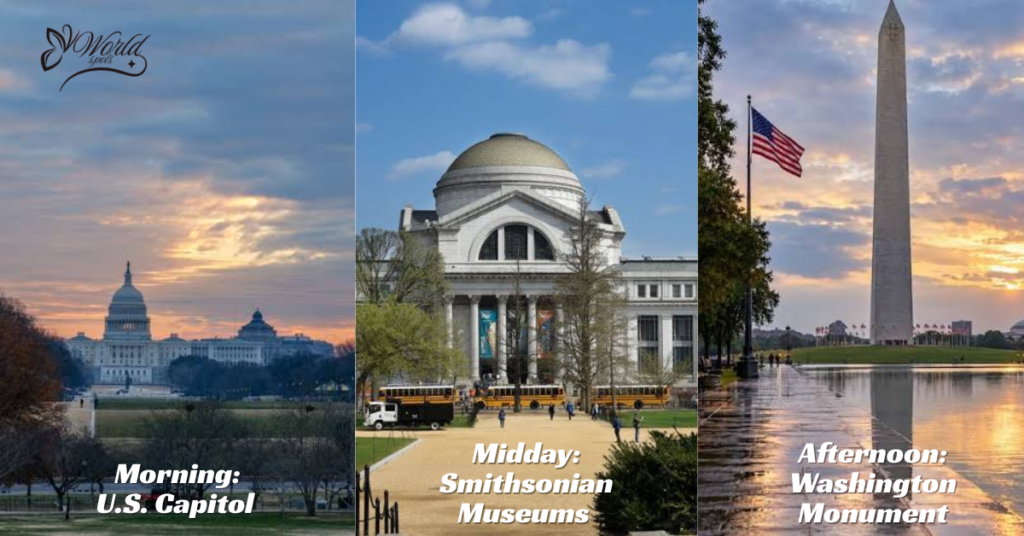
Morning: U.S. Capitol and Library of Congress
Begin at the U.S. Capitol, home of Congress. Visitors enter through the underground Capitol Visitor Center, which is open Monday to Saturday, 8:30 a.m.–4:30 p.m. The guided tour is free, but reserve a slot on the official visitor website; walk-up passes go fast, and the last tour starts at 3:20 p.m.
Two things to know: no food or drinks are allowed inside, and there’s no bag storage, so travel light.
From the Capitol, a tunnel leads straight to the Library of Congress. The Thomas Jefferson Building is arguably the most beautiful interior in the city; gilded ceilings, marble staircases, and the domed Main Reading Room viewed from the gallery above. Free timed-entry tickets are recommended.
Step outside for a photo of the Supreme Court across the street, then head down Capitol Hill toward the Mall.
Midday: Smithsonian Museums on the Mall
You can’t see every Smithsonian museum in one trip, so pick one or two by interest:
- National Museum of Natural History; the Hope Diamond, dinosaur hall, and the ocean hall. No pass needed.
- National Air and Space Museum; its multi-year renovation wraps up in fall 2026, so 2027 visitors will see every gallery open for the first time in years. Free timed-entry passes are required.
- National Museum of American History: the Star-Spangled Banner and First Ladies’ gowns.
Lunch tip: museum cafés are pricey and crowded. Food trucks line the streets near the Mall on weekdays.
Afternoon: Washington Monument and the Memorials
Next, the Washington Monument. An elevator takes you to the observation level for the best 360-degree view of D. C. . Entry is free, but tickets are required for everyone aged 2+:
- Advance tickets are released on recreation.gov 30 days ahead at 10 a.m. ET ($1 fee per ticket).
- Next-day tickets are released at 3 p.m. the day before.
- Free same-day tickets are handed out at the Washington Monument Lodge on 15th Street from 8:45 a.m., first come, first served.
From the monument, walk west past the World War II Memorial, along the Lincoln Memorial Reflecting Pool, to the Lincoln Memorial itself. On the way, detour to the Vietnam Veterans Memorial and the Korean War Veterans Memorial; both hit harder in person than any photo suggests.
New in 2026: the Lincoln Memorial Undercroft opened as a free exhibit beneath the memorial. It uses timed-entry tickets on recreation.gov ($1 reservation fee).
Evening: The Monuments by Night
Grab dinner, then come back. The memorials are open 24 hours and lit after dark, and the crowds disappear. Seeing Lincoln glowing at 10 p.m. is a highlight many visitors rank above anything they did in daylight.
Day 2: White House, National Archives and Penn Quarter

Morning: The White House
Even without a tour, you can photograph the White House from Lafayette Square (north side) and The Ellipse (south side). Inside tours are free and self-guided, but:
- U.S. citizens request tours through their Member of Congress, generally 21 days to 3 months ahead.
- International visitors go through their embassy in Washington.
- Expect a shorter route than older guides describe; the East Wing was demolished in 2025 for the new ballroom project.
- Bring a REAL ID or passport.
Next door, the Renwick Gallery (free, Smithsonian) is a small, fun museum of contemporary craft and art installations; a perfect 45-minute stop.
Midday: National Archives
Walk east along Pennsylvania Avenue to the National Archives Museum, where the original Declaration of Independence, Constitution, and Bill of Rights are displayed in the Rotunda. Entry is free; reserving a timed slot lets you skip the general line in busy months.
Afternoon: African American History Museum
The National Museum of African American History and Culture (NMAAHC) is the most in-demand museum in D. C., and for good reason. Start in the underground history galleries and work your way up. Free timed-entry passes are required for every visitor, including babies:
- Advance passes are released 30 days ahead on a rolling basis.
- Same-day passes release online at 8:15 a.m. ET.
Evening: National Portrait Gallery and Penn Quarter
The National Portrait Gallery and Smithsonian American Art Museum share one building and stay open later than the Mall museums. Don’t miss the presidential portraits, then step into the glass-roofed Kogod Courtyard. Finish with dinner in Penn Quarter or Chinatown, one of the city’s liveliest restaurant areas.
Day 3: Tidal Basin Memorials, Arlington or Georgetown
Morning: Tidal Basin Loop
The Tidal Basin loop (about 2 miles) links three powerful memorials:
- Thomas Jefferson Memorial; domed and facing the White House across the water.
- Franklin Delano Roosevelt Memorial; four outdoor “rooms,” one for each of FDR’s terms.
- Martin Luther King Jr. Memorial; the “Stone of Hope” carved from granite.
Afternoon: Choose Your Adventure
Option A: Arlington National Cemetery. One Metro stop across the Potomac. Watch the Changing of the Guard at the Tomb of the Unknown Soldier, visit the John F. Kennedy gravesite, and walk up to Arlington House for a sweeping view of D. C. . Entry is free.
Option B: Georgetown. Cobblestone streets, the C&O Canal towpath, waterfront dining and shopping along M Street. Film fans will want the famous steep staircase from The Exorcist.
Evening: The Wharf
End your trip at The Wharf, D. C.’s waterfront district on the Southwest Channel; seafood, rooftop bars, and free live music on summer weekends.
Family Itinerary: Washington, D. C.
D. C. might be the best-value family destination in the U.S.; the headline attractions are free, many have hands-on zones for kids, and the Metro makes moving around easy. Children under 5 ride Metro free with a paying adult (up to two kids per adult).
Day 1: Dinosaurs, Rockets and the Carousel
- Morning: National Museum of Natural History; dinosaurs, the Butterfly Pavilion (small fee) and the live Insect Zoo.
- Midday: Picnic on the Mall, then ride the vintage carousel outside the Smithsonian Castle.
- Afternoon: National Air and Space Museum; the new “How Things Fly” gallery is built for hands-on learning. Book passes ahead.
Day 2: The National Zoo and Planet Word
Smithsonian’s National Zoo
The National Zoo is free, and the giant pandas are back; Bao Li and Qing Bao arrived from China in late 2024. Go early: the animals are most active in the morning, and the hill back to the entrance is steep with a stroller.
Planet Word
This free language museum downtown has a karaoke room, a talking word wall, and a magic library. Timed passes are recommended for ages 2+.
Day 3: Monuments Made Kid-Friendly
Turn the Mall into a game: hand kids a list of memorials to “find.” In warm months, rent a paddle boat on the Tidal Basin, then finish with the interactive International Spy Museum at L’Enfant Plaza (paid entry; great for ages 8+).
Family Tips That Save Your Sanity
- Strollers are allowed in most museums; the Capitol Visitor Center has baby-changing stations in its family restrooms.
- Build in one indoor stop per afternoon in summer; D. C. heat is no joke.
- Use Junior Ranger booklets from the National Park Service at the monuments.
Planning a bigger U.S. family trip? See our guide to family-friendly activities.
Weekend in D. C. Itinerary
Only have Saturday and Sunday? You can still hit the essentials, but remember the Capitol Visitor Center is closed on Sundays, so the Capitol has to happen on Saturday.
Saturday: Capitol to Lincoln
Morning
U.S. Capitol tour (book ahead) → Library of Congress → walk the Mall.
Afternoon
One Smithsonian museum → Washington Monument (reserve your ticket 30 days out) → WWII Memorial → Lincoln Memorial.
Evening
Dinner on 14th Street or U Street, where you’ll find the legendary Ben’s Chili Bowl, a D. C. institution since 1958.
Sunday: White House, Archives and Tidal Basin
Morning
White House exterior photos → National Archives (opens at 10 a.m.).
Afternoon
NMAAHC (passes required) or the National Gallery of Art, then a sunset walk around the Tidal Basin memorials.
Only Have One Day in Washington, D. C.?
Short layover or day trip? Follow this one-day D. C. itinerary:
- 8:00 a.m.; Lincoln Memorial before the crowds
- 9:00 a.m.; Vietnam, Korean War, and WWII memorials
- 10:30 a.m.; Washington Monument (with tickets)
- 12:00 p.m.; Natural History Museum + lunch
- 2:30 p.m.; U.S. Capitol tour (book the 2:30–3:20 slot)
- 4:30 p.m.; White House exterior via Pennsylvania Avenue
- Evening; dinner in Penn Quarter, monuments by night
Cherry Blossom D. C. Itinerary
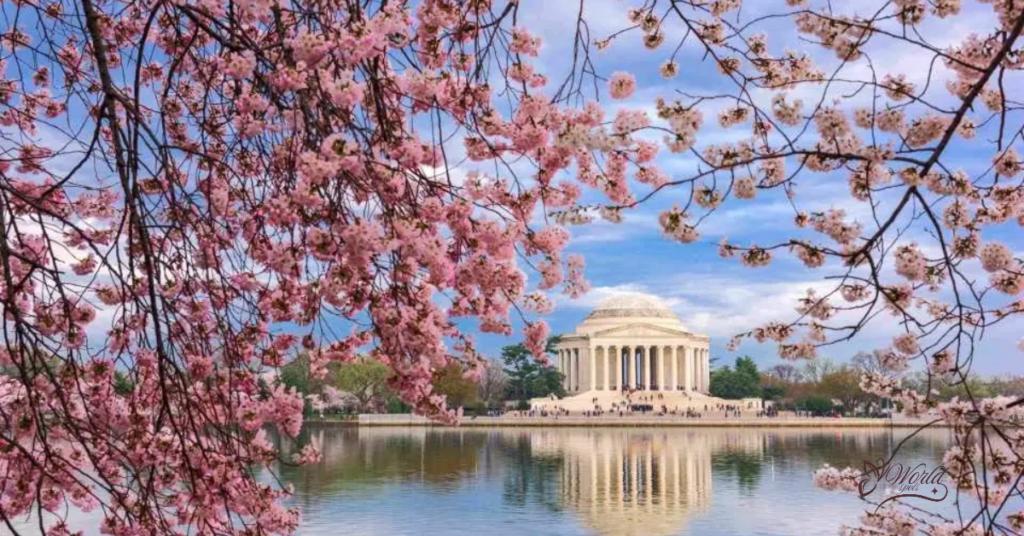
Spring in D. C. belongs to the cherry blossoms, a gift of 3,000 trees from the mayor of Tokyo in 1912. 2027 is a special year: the National Cherry Blossom Festival celebrates its 100th anniversary, with expanded events planned for the centennial. The festival is expected to run from around March 20 to mid-April 2027.
Peak bloom, when most of the Yoshino blossoms are open, usually lands between late March and early April, and only lasts a few days. The National Park Service announces its prediction in early March, so keep your plans flexible.
Day 1: Sunrise at the Tidal Basin
Sunrise
Arrive before 6:30 a.m. Photographers line up for the Jefferson Memorial framed by blossoms, and by 9 a.m. the paths are shoulder to shoulder.
Late Morning
Walk the full loop past the FDR Memorial and MLK Memorial, then grab a snack at the festival’s official welcome area near the Tidal Basin.
Afternoon
Escape the crowds in East Potomac Park (Hains Point), where the later-blooming Kwanzan trees add a second wave of deep pink.
Day 2: Festival Events and Quieter Blooms
- Blossom Kite Festival on the Washington Monument grounds.
- National Cherry Blossom Festival Parade along Constitution Avenue (grandstand tickets are paid; standing room is free).
- Petalpalooza: an all-day outdoor party with live music and fireworks.
For calmer viewing, try the U.S. National Arboretum or the gardens at Dumbarton Oaks in Georgetown.
Cherry Blossom Survival Tips
- Don’t drive. Take Metro to Smithsonian station and walk 15 minutes.
- Book hotels early; rates spike during peak bloom.
- Weekday mornings beat weekend afternoons every time.
- Never pick or climb the trees; it’s illegal and damages them.
Planning Your Washington, D. C. Itinerary
Tickets and Timed-Entry Passes to Book in Advance
This is where most first-timers go wrong. Use this checklist:
| Attraction | Cost | How to book | When to book |
| Washington Monument | Free + $1 fee | recreation.gov | 30 days ahead, 10 a.m. ET |
| U.S. Capitol tour | Free | Capitol Visitor Center website | As early as possible |
| NMAAHC | Free | Smithsonian website | 30 days ahead; same-day 8:15 a.m. |
| Air and Space Museum | Free | Smithsonian website | When dates open |
| White House | Free | Member of Congress/embassy | 21 days–3 months ahead |
| Lincoln Memorial Undercroft | Free + $1 fee | recreation.gov | 30 days ahead |
Getting Around Washington, D. C.
Metro
The Metro is clean, fast, and covers every major sight. Rail fares run 2.25–6.75 per ride, and the 1-Day Unlimited Pass costs $13.50 (or $33.75 for 3 days). Tap a SmarTrip card, phone wallet, or contactless bank card at the gates.
On the Mall, walking is fastest. For longer hops, Capital Bikeshare docks are everywhere.
Airports
Reagan National ( D. C. A) is closest and on the Metro. Dulles (IAD) connects via the Silver Line. BWI is linked by MARC or Amtrak train.
Where to Stay in Washington, D. C.
Penn Quarter / Downtown
Best for first-timers; walk to the Mall, museums, and restaurants.
Capitol Hill
Quieter streets, historic row houses, and Eastern Market on weekends.
Dupont Circle and Logan Circle
Great dining and nightlife, two Metro stops from the action.
Georgetown
Charming and walkable, but no Metro station.
Arlington, Virginia (Rosslyn / Crystal City)
Usually cheaper, and only minutes away on the Metro.
Best Time to Visit Washington, D. C.
- Spring (March–May): cherry blossoms and pleasant weather, but peak crowds and prices.
- Summer (June–August): hot and humid; July 4th fireworks on the Mall.
- Fall (September–November): the best balance; mild weather, fall color, and thinner crowds.
- Winter (December–February): cheapest hotels and holiday lights; the National Christmas Tree on the Ellipse.
How Much Does a Washington, D. C. Trip Cost?
The attractions cost almost nothing, so your budget goes to hotels and food. Expect hotels to be your biggest expense, especially in spring. Save by staying in Arlington, eating lunch from food trucks, and buying a Metro pass instead of taking rideshares.
Washington, D. C. Itinerary FAQs
How many days do you need in Washington, D. C.?
Three days is ideal for first-time visitors; enough for the National Mall, a few museums, the White House area, and one neighborhood. With two days, you can cover the highlights; with four or five, you can add Mount Vernon, Alexandria, or more museum time.
Are the museums in Washington, D. C., really free?
Yes. All Smithsonian museums and the National Zoo are free, as are the National Gallery of Art, National Archives, and Library of Congress. A few popular sites require free timed-entry passes, and private attractions like the International Spy Museum charge admission.
Can you tour the White House without booking ahead?
No. Public tours must be requested in advance, through your Member of Congress if you’re a U.S. citizen, or your embassy if you’re an international visitor. Without a tour, you can still see the White House from Lafayette Square and the Ellipse.
When is the best time to see the cherry blossoms in D. C.?
Peak bloom usually falls between late March and early April. In 2027, the National Cherry Blossom Festival marks its 100th anniversary, so expect bigger crowds than usual; book early.
Is Washington, D. C. walkable?
Very. The National Mall is about 2 miles end to end, and most major sights are within walking distance of each other. Use the Metro to reach Arlington, the Zoo, and outer neighborhoods.
What should I skip on a short D. C. trip?
On a one- or two-day visit, skip trying to “do” every museum. Choose one or two Smithsonian museums and spend the saved time at the monuments, which are the experiences you can’t get anywhere else.
Final Thoughts:
The secret to a great D. C. itinerary isn’t squeezing in more sights; it’s booking the right passes early, grouping attractions by zone, and saving the monuments for night when the city goes quiet. Follow this plan, and you’ll see the capital the way locals wish every visitor would.
Exploring more of the U.S.? Don’t miss our guide to the places to visit in America.

