


Last updated:
In a single week in the Northeast, you can walk the room where the US Constitution was written, feel the spray of Niagara Falls, and drive to a lighthouse that George Washington helped to create. Few parts of America pack in so much history and scenery so close together.
This guide shows you what to see in each state, the true stories behind each place, and what it costs in 2026.
Landmarks and Famous Sites Northeast Region, US at a Glance
The US Census Bureau counts nine states in the Northeast. They split into two groups: New England (Connecticut, Maine, Massachusetts, New Hampshire, Rhode Island, and Vermont) and the Middle Atlantic (New York, New Jersey, and Pennsylvania).
Short on time? Start with these:
| Landmark | State | Famous for | Adult cost (2026) |
| Statue of Liberty | New York | Symbol of freedom | From about $25.50 |
| Empire State Building | New York | Art Deco skyscraper | From $44 |
| Brooklyn Bridge | New York | 1883 engineering feat | Free to walk |
| Central Park | New York | City’s great green space | Free |
| Niagara Falls | New York | Thundering waterfalls | Free park entry |
| Freedom Trail | Massachusetts | 16 Revolutionary sites | Free to walk |
| Independence Hall | Pennsylvania | Birthplace of the nation | $1 booking fee |
| Gettysburg | Pennsylvania | Civil War turning point | Battlefield free |
| Fallingwater | Pennsylvania | House over a waterfall | From $42 |
| The Breakers | Rhode Island | Gilded Age mansion | $32 |
| Acadia National Park | Maine | Rocky Atlantic coast | $35 per vehicle |
| Mount Washington | New Hampshire | Highest Northeast peak | Varies by route |
Landmarks and Famous Places in the Northeast, State by State
The states here are small, so you can easily link several places into one trip. Start with whichever city you fly into, then work outward.
New York: The Icons Everyone Knows
New York holds more famous names than any other Northeast state.
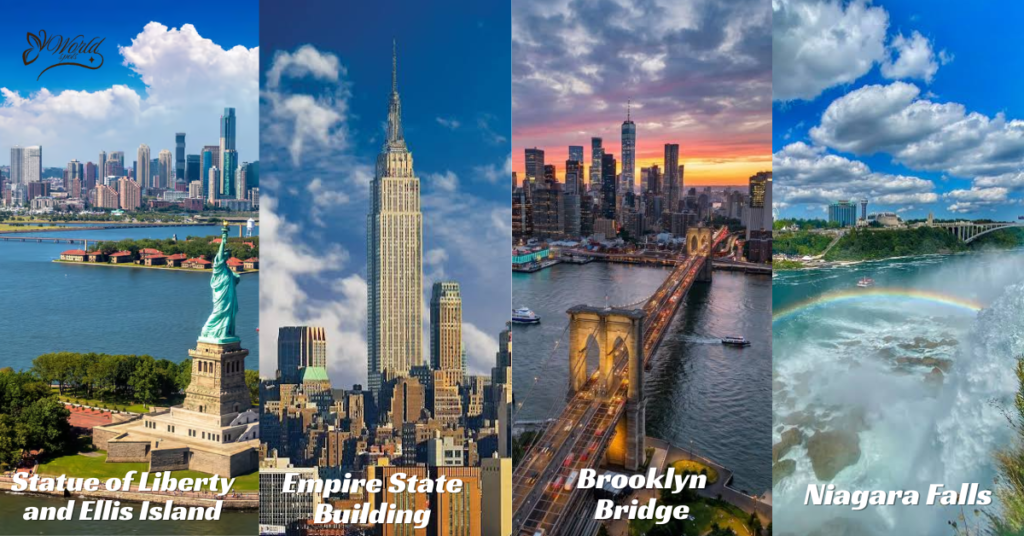
i. Statue of Liberty and Ellis Island
A gift from the people of France, the statue was dedicated on October 28, 1886, and stands 305 feet from the ground to the torch. Ferries run continuously out of Manhattan’s Battery Park alongside New Jersey’s Liberty State Park. Each entry pass grants access to Ellis Island, the historic gateway that welcomed more than 12 million newcomers between 1892 and 1954.
Plan for this one:
- Crown: advance tickets are required, and you must climb at least 162 steps on a narrow spiral staircase. Tickets often sell out months ahead.
- Timing: take an early ferry if you want to see both islands in one day.
ii. Empire State Building
Opened in 1931 after about 13 months of construction, this 102-story tower was the world’s tallest building for decades. The 86th-floor deck gives you a classic open-air view from 1,050 feet, and the 102nd floor adds 200 feet more for a higher price.
iii. Brooklyn Bridge
Opened on May 24, 1883, the bridge is about 1.1 miles long, including its approaches. Walk it on the raised pedestrian promenade, which has been for walkers only since cyclists got their own lane in 2021. Go early, because it gets very crowded by midday.
iv. Central Park
At 843 acres, this National Historic Landmark runs 2.5 miles through Manhattan and is the most visited urban park in the US. Frederick Law Olmsted and Calvert Vaux won the design contest in 1858. It is free, so it makes a perfect break between paid attractions.
v. Niagara Falls
Niagara Falls State Park, created in 1885, is claimed to be the oldest continuously operating state park in the US, and there is no general admission fee. From Goat Island, you get close to the American, Bridal Veil, and Horseshoe Falls. Maid of the Mist and Cave of the Winds cost extra and can sell out early.
Massachusetts: Where the Revolution Began
Boston is one of the easiest cities in America to explore on foot, and its best-known landmark is literally a walk.
i. The Freedom Trail
This 2.5-mile route links 16 historic sites, from Boston Common to Charlestown. Walking it is free, though some sites charge admission. Don’t miss these:
- Faneuil Hall: the 1742 meeting hall known as the “Cradle of Liberty”
- Paul Revere House and Old North Church in the North End
- USS Constitution: launched in 1797 and the world’s oldest commissioned warship still afloat
Pennsylvania: From Independence to Fallingwater
Pennsylvania tells America’s story at both of its greatest turning points, and it adds one of the world’s most admired houses.
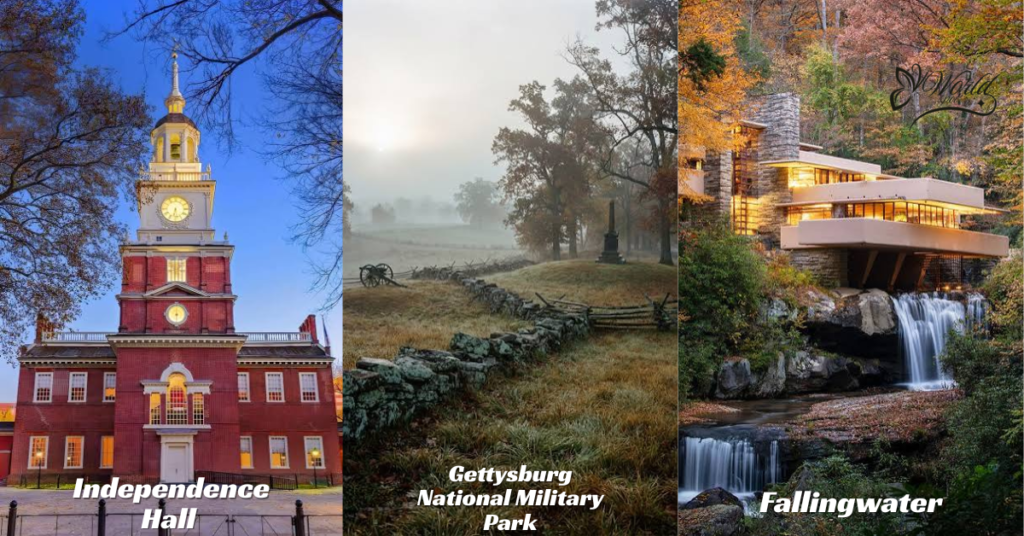
i. Independence Hall and the Liberty Bell
The Declaration of Independence was adopted here in 1776, and the US Constitution was drafted here in 1787. Tickets are free, apart from a $1 reservation fee. You can book up to 30 days ahead on Recreation.gov, or try for next-day tickets at 5 p.m. the day before.
The Liberty Bell is a short walk away and needs no ticket.
ii. Gettysburg National Military Park
Fought from July 1 to 3, 1863, this was the bloodiest battle of the Civil War, with roughly 46,000 to 51,000 casualties. The battlefield itself is free. The visitor center’s film, cyclorama, and museum cost $20.75 for adults and are worth buying first, because they make sense of the landscape you are about to see.
iii. Fallingwater
Frank Lloyd Wright designed this house over a waterfall in 1935, and 2026 marks its 90th anniversary, following a three-year preservation project. It is about 90 minutes from Pittsburgh, tours are closed on Wednesdays, and you must reserve ahead. The guided tour costs $42, and children under 6 can’t join it.
Rhode Island: Gilded Age Glamour
i. The Breakers
Built from 1893 to 1895 for Cornelius Vanderbilt II, this 70-room mansion is the star of Newport’s oceanfront estates. Adult tickets cost $32 and are sold for a specific date and time, so book before you drive down.
Maine: Lighthouses and Atlantic Granite
Maine’s coast is the wild counterpoint to all those cities, and it rewards anyone willing to drive a few extra hours.
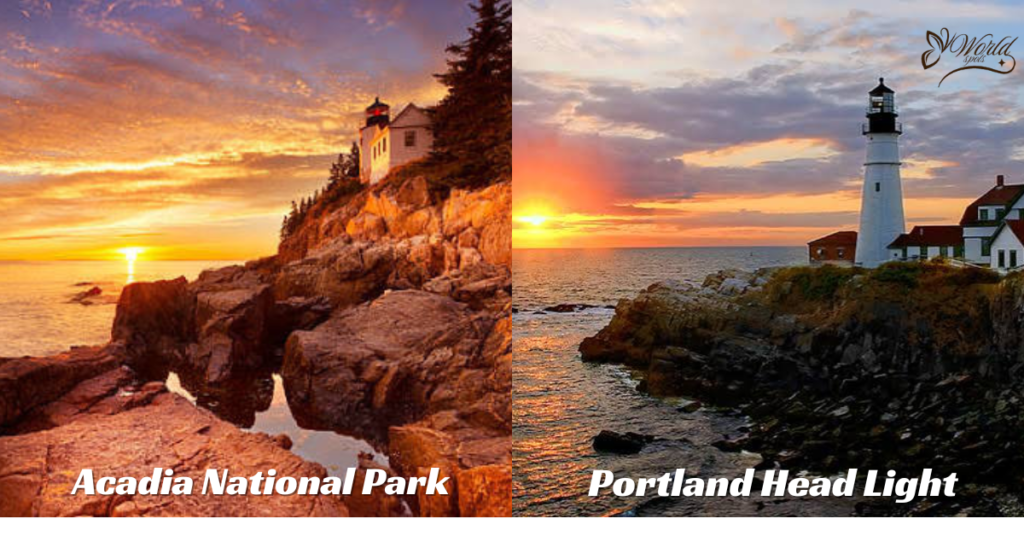
i. Acadia National Park
Acadia mixes pink granite shoreline, forest, and Cadillac Mountain. A vehicle pass costs $35 for seven days. Driving up Cadillac needs a separate $6 timed reservation from May 20 to October 25, sold online only.
International visitors, take note: since January 2026, non-US residents aged 16 or older pay an extra $100 per person at Acadia, unless they hold an annual pass. It is the only Northeast park on the list of 11 charging this fee.
ii. Portland Head Light
First lit in 1791, this is Maine’s oldest lighthouse and the first built by the US government. It stands in Fort Williams Park, just outside Portland, and the old keeper’s house is now a small maritime museum.
New Hampshire: The Top of the Northeast
i. Mount Washington
At 6,288 feet, this is the highest peak in the Northeast. You can hike, drive the Auto Road, or ride the Cog Railway to the top. Pack warm layers even in summer, because the weather up there is famously severe.
Connecticut, New Jersey and Vermont: Three Smaller Stops
The remaining three states have fewer household names, but each has a worthwhile stop:
- Connecticut: the Mark Twain House in Hartford, the author’s family home
- New Jersey: Thomas Edison National Historical Park in West Orange, the inventor’s laboratory and estate
- Vermont: the Bennington Battle Monument, a 306-foot stone obelisk and the state’s tallest structure
Landmarks Famous in the World: Why the Northeast Stands Out
The Northeast holds several landmarks famous around the world, and a few of them have international connections that surprise people.
i) Three UNESCO World Heritage Listings
Three places in this guide appear on the UNESCO World Heritage List:
- Independence Hall (1979)
- Statue of Liberty (1984)
- Fallingwater (2019, with other Frank Lloyd Wright buildings)
ii) The Eiffel Connection
The Statue of Liberty is partly French engineering. Frédéric Auguste Bartholdi sculpted it, and Gustave Eiffel, of Eiffel Tower fame, built the iron framework inside it.
Niagara is an international landmark in the literal sense, as the Horseshoe Falls straddles the US-Canada border. The New York side gets you close to the water, while the Canadian side is known for its wider view. If you plan to cross, carry your passport and check your entry rules first.
Famous Landmarks and Their Names: What They Really Mean
Many of these landmarks began with different names. Knowing the stories behind them makes for a better visit, and a good bit of trivia along the way.
| Today’s name | Original or full name | The story |
| Statue of Liberty | The Statue of Liberty Enlightening the World | The official title is far longer |
| Independence Hall | Pennsylvania State House | Renamed in the 1820s |
| Liberty Bell | State House Bell | Renamed by abolitionists |
| Old Ironsides | USS Constitution | A nickname from battle |
| Faneuil Hall | Same name | Named for donor Peter Faneuil |
| Empire State Building | Same name | “Empire State” is New York’s nickname |
| Fallingwater | Kaufmann residence | Named for the falls beneath it |
| The Breakers | Same name | Named for waves breaking on the rocks below |
| Mount Washington | Same name | Honors George Washington |
Famous Landmarks and Tourist Attractions: How to Plan Your Trip
The landmarks above are the highlights, but the best trips mix in other tourist attractions too. Here is how to fit it all together.
Attractions to Add Along the Way
Fall foliage: New England’s autumn colors draw visitors from around the world, usually peaking from late September into October, with the far north turning first.
Museums: New York, Boston, and Philadelphia all have world-class collections, which make a good rainy-day backup.
More of America: our guide to places to visit in America covers the rest of the country.
How to Get Around
- Train: Amtrak’s Northeast Corridor links Boston, New York, and Philadelphia, and it is often easier than driving and paying for city parking.
- Car: You will need one for Acadia, Mount Washington, Fallingwater, and Gettysburg. Pick it up as you leave the city, not before.
- On foot: Boston and central Philadelphia are compact enough to explore without any transport for most of the day.
When to Go
- Spring: mild weather and smaller crowds, though some seasonal attractions are only just opening.
- Summer: everything is open, but expect peak prices and queues, plus heat in the cities.
- Fall: the favorite season for many, with cool air and foliage. Book rooms early, particularly in New England.
- Winter: cold and snowy, with low crowds in cities, but mountain and coastal roads may be limited.
Booking Checklist
Book these first, as they are the most likely to sell out or need a timed slot:
- Statue of Liberty crown: as early as you can
- Independence Hall: up to 30 days ahead
- Fallingwater tours: required in advance
- Cadillac Summit Road: in season, online only
- The Breakers: timed tickets for a set date
A Simple 7-Day Route
- Days 1 to 3: New York City, including the Statue of Liberty, Brooklyn Bridge, Central Park and the Empire State Building
- Day 4: Train to Philadelphia for Independence Hall and the Liberty Bell
- Day 5: Train to Boston and walk the Freedom Trail
- Day 6: Rent a car and visit Newport for The Breakers
- Day 7: Drive north to Portland Head Light
With extra days, add Acadia, Mount Washington, or Niagara Falls. Note that Niagara sits in far western New York, so it needs its own leg.
Frequently Asked Questions
What are the most famous landmarks in the Northeast US?
The best-known are the Statue of Liberty, Empire State Building, Brooklyn Bridge, Independence Hall, the Freedom Trail, and Niagara Falls. For nature, add Acadia and Mount Washington.
Which states are in the Northeast region?
The Census Bureau lists nine: Connecticut, Maine, Massachusetts, New Hampshire, New Jersey, New York, Pennsylvania, Rhode Island, and Vermont. Some school materials also add Delaware and Maryland.
Is the Liberty Bell free to visit?
Yes. No ticket is required. Independence Hall nearby is also free to enter, but its tickets carry a $1 reservation fee.
How much does it cost foreign visitors to enter Acadia?
Non-US residents aged 16 or older pay an extra $100 per person on top of the normal entrance fee, unless they hold an annual pass.
How many days do you need to see the Northeast?
Seven days cover New York, Philadelphia, Boston, and Newport. Allow 10 to 14 days to add Maine, New Hampshire, and Niagara Falls.
What is the best time to visit?
Late September to mid-October is hard to beat for foliage and comfortable walking weather, though summer is best if you want every seasonal attraction open.
Start With One City
You can’t see every landmark and famous site in the Northeast region of the US in one trip, and you don’t need to. Choose one city, walk its history, and let the next destination come naturally. When you are ready for more, our Guide for Places to Visit Around the World has plenty of ideas.

